
Precious metals price declines stem from retail pile-in, safe haven and debasement trades remain intact – Brookings’ Brooks
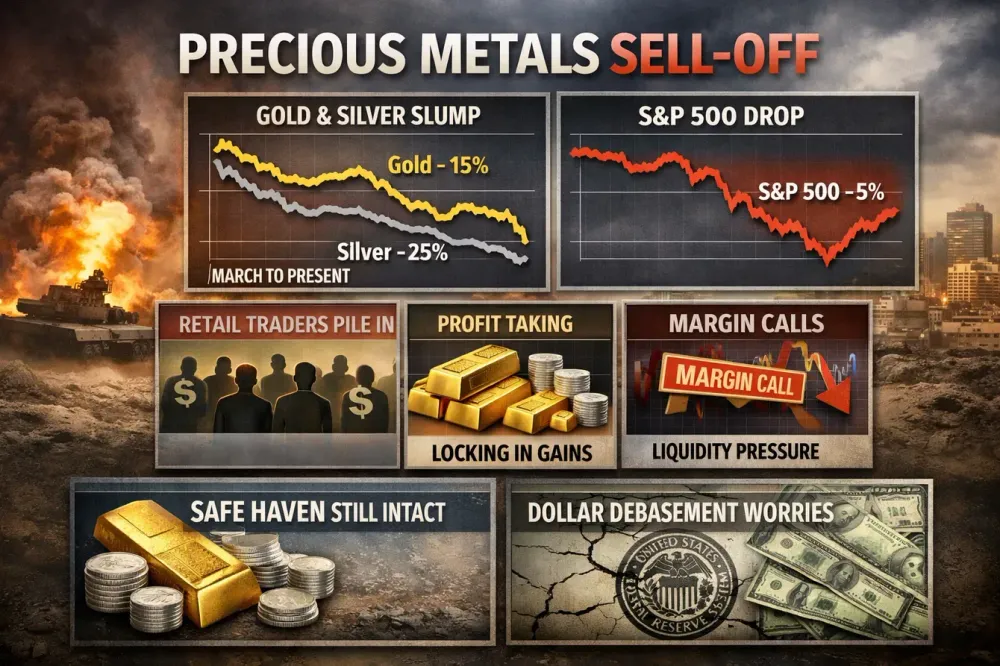
While popular explanations for gold’s decline challenge the yellow metal’s status as a safe haven or cast doubt on the continuance of the U.S. dollar debasement trend, the real driver of precious metals’ price action since the start if the Iran conflict is the massive recent growth of retail traders in the metals market, according to Robin Brooks, Senior Fellow at the Brookings Institution and former Chief Economist at IIF and Chief FX Strategist at Goldman Sachs.
In an analysis published Wednesday, Brooks unpacked some of the popular explanations for why precious metals prices have declined during the Iran conflict.
“There’s three theories that are doing the rounds in markets,” he wrote. “First, the crazy run-up in precious metals before the war no doubt sucked in lots of retail investors who didn’t trade things like gold before. It’s reasonable to think that this broader investor base may change how precious metals trade, making them behave more like risk assets rather than safe haven assets. That’s consistent with gold selling off on oil price spikes and rallying - in the last day or two - on expectations of detente.”
The second commonly held belief is that many investors were sitting on big gains in their precious metals positions following the dramatic rally in late 2025 and early this year. “A rise in uncertainty makes you want to take your chips off the table, so people - reasonably - may have locked in some of those gains,” Brooks noted.
The third explanation holds that the rise in overall market volatility put other positions, especially among hedge funds, in the red. “That kind of thing means people get hit with margin calls, for which they need liquidity,” he wrote. “That might see them sell profitable positions to free up cash. Gold will have been one of those positions.”
Brooks doesn’t believe that any of these things invalidate the safe-haven status of gold, nor the debasement trade that has also supported the yellow metal’s price. “They do signal that the buyer base may have broadened, which is why we’re seeing atypical price action now,” he said.
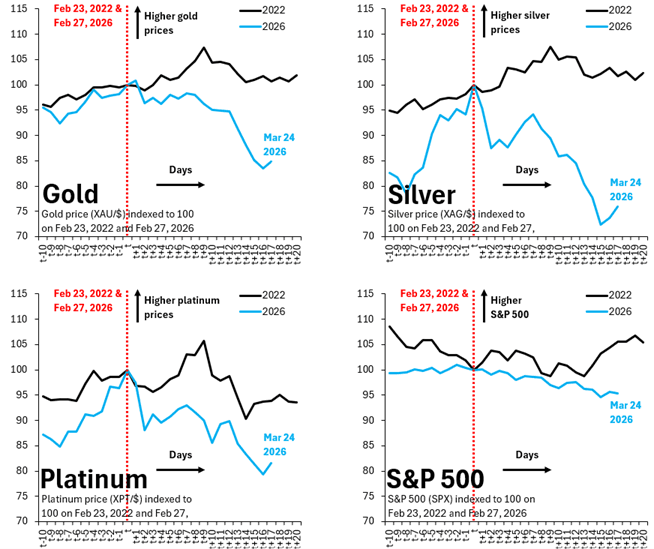
Brooks shared four charts showing the price action in gold, silver, platinum and the S&P 500 since the start of the Iran conflict, combined with the assets’ performance following the Russian invasion of Ukraine in 2022.
“First, all precious metals are down since the outbreak of war,” he noted. “Gold is down 15 percent, silver is down 25 percent and platinum is down 20 percent. To put this in perspective, the S&P 500 is down five percent over the same period. Precious metals have thus clearly underperformed.”
“Second, a fall in the S&P 500 of five percent hardly qualifies as a big risk-off, which means that the safe-haven status of gold won’t have been triggered,” Brooks said. “That makes me inclined to think recent declines are a vestige of the huge run up in precious metals prices and positioning. Third, Russia’s invasion of Ukraine didn’t really trigger much of a rally in gold or other precious metals and the S&P 500 - on a similar time scale - is almost identical to now. That again leans in the direction of this being a positioning purge.”
Brooks said his own favored explanation for the recent sell-off is that the dramatic precious metals price rally that preceded the Iran conflict served to significantly broaden the investor base.
“It’s possible that this - at least right now - is making precious metals trade more like risk assets, which would explain why they fell as the conflict escalated and - in recent days - rallied as signs of detente emerged,” he said. “It’s also likely that high volatility hit some parts of the market hard. It’s not unusual for profitable positions to get liquidated when people get hit with margin calls for trades that are underwater. Lastly, it’d be perfectly reasonable for people to lock in gains as uncertainty rises. You take your chips off the table when you don’t understand what’s going on.”
“None of these explanations invalidate the debasement trade, of which I’ve become a fan,” Brooks concluded. “After all, fiscal policy in the US and elsewhere is just as reckless as before the war, so the search for safe havens from debt monetization will persist.”
After hitting a session high of $4,602.64 in overnight trading and retesting near-term support around $4,530 per ounce, the yellow metal continues to set higher lows on Wednesday as the price action compresses within a $50 range.
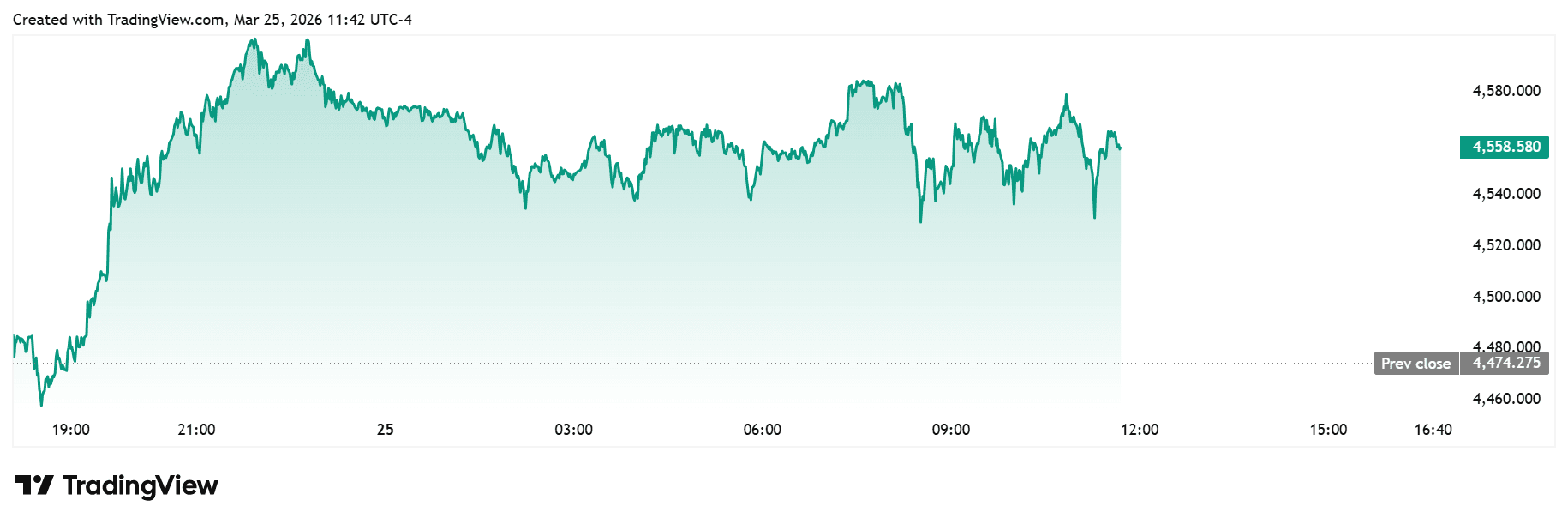
Spot gold last traded at $4,559.00 per ounce for a gain of 1.89% on the session.