
Gold dips as Fed votes 11-1 in favor of rate hold, but three dissent on easing bias
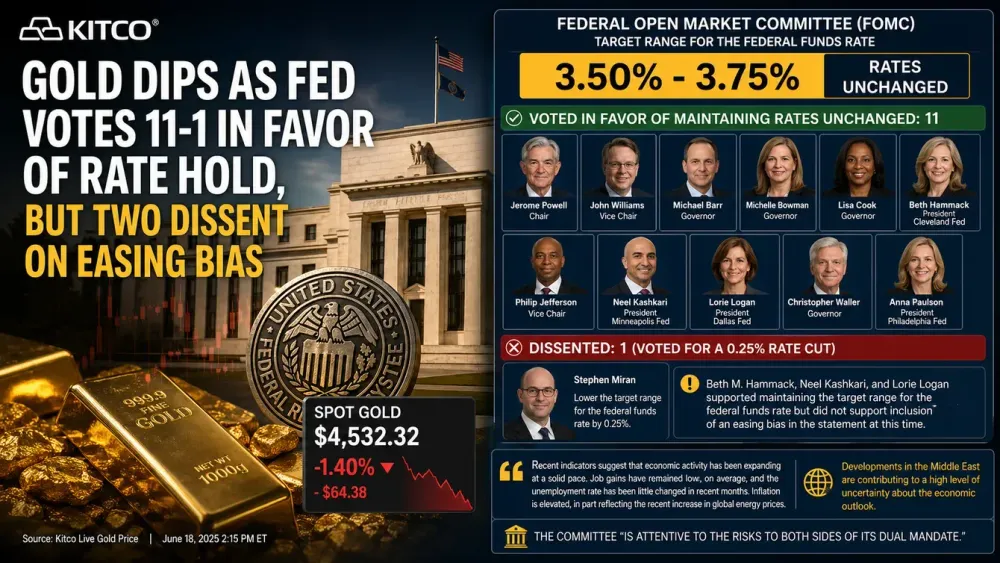
The Federal Reserve announced on Wednesday that the Federal Open Market Committee (FOMC) has decided to maintain the target range for the federal funds rate at 3.50% to 3.75%, as expected by the market consensus, but while the vote for a hold was nearly unanimous, fresh dissension emerged in Committee members’ views of the balance of risk.
“Recent indicators suggest that economic activity has been expanding at a solid pace,” the Federal Reserve said in their statement. “Job gains have remained low, on average, and the unemployment rate has been little changed in recent months. Inflation is elevated, in part reflecting the recent increase in global energy prices.”
The FOMC noted that “developments in the Middle East are contributing to a high level of uncertainty about the economic outlook,” and said the Committee “is attentive to the risks to both sides of its dual mandate.”
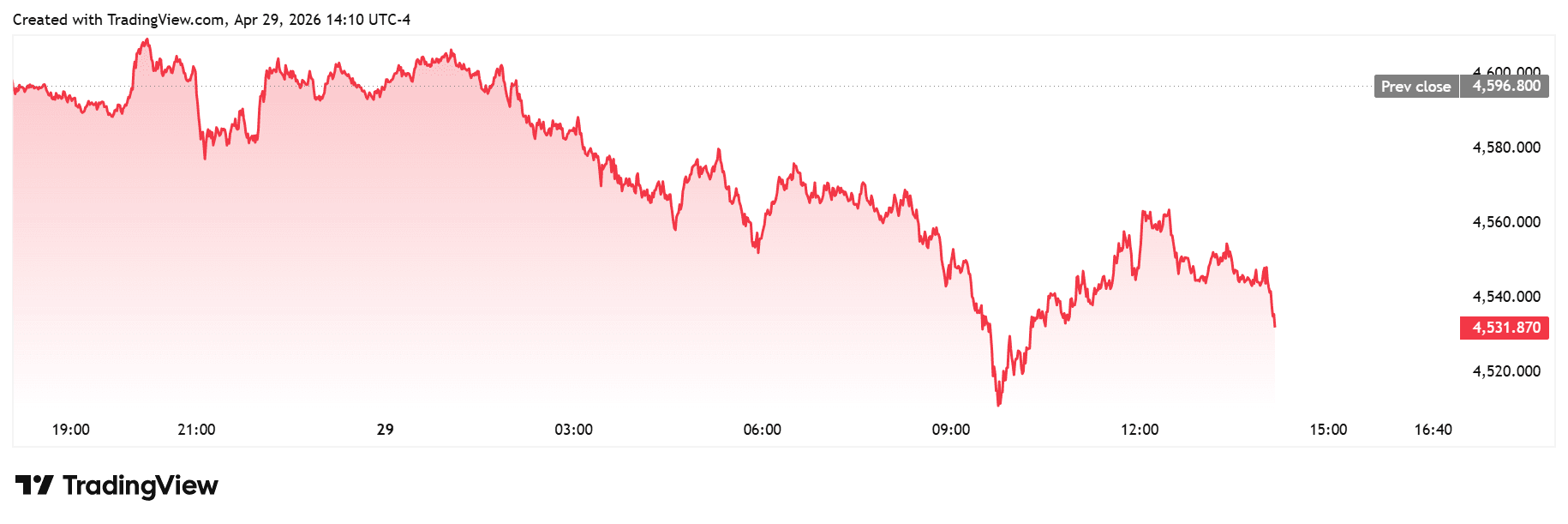
Gold prices dipped in the wake of the announcement, with spot gold last trading at $4,532.32 per ounce for a loss of 1.40% on the session.
11 FOMC members voted in favor of maintaining rates unchanged: Chair Jerome Powell, Vice Chair John Williams, Michael Barr; Michelle Bowman; Lisa Cook; Beth Hammack; Philip Jefferson; Neel Kashkari; Lorie Logan; Christopher Waller; and Anna Paulson. The lone dissenters were Stephen Miran, who argued for lowering the target range for the federal funds rate by 0.25%.
“Beth M. Hammack, Neel Kashkari, and Lorie Logan supported maintaining the target range for the federal funds rate but did not support inclusion of an easing bias in the statement at this time,” the statement noted.
Jeffrey Roach, Chief Economist at LPL Financial, said Powell is no longer a consensus builder.
"In a dramatic twist for Chair Powell, three regional presidents dissented, not over the rate decision itself, but over how it was communicated," he said. "Expect additional tension as a new Fed chair attempts to implement a new policy regime."
"Expect more dissents in the near term and expect more volatility in the rates markets," Roach said. "The incoming chair will face challenges building consensus around a new policy regime, particularly since the Fed completed a formal review of its policy framework just last year, in 2025. Further, it’s no surprise that potential rate hikes are priced back in the futures markets. Ultimately, uncertainty will remain until the Middle East conflict is decidedly over."