
Wall Street predicts higher gold prices following regional ceasefire as domestic data and Fed chair confirmation take center stage next week

The gold market delivered its fourth straight positive weekly performance, helped considerably by the announcement of a ceasefire between Israel and Hezbollah and the full reopening of the Strait of Hormuz on Friday morning.
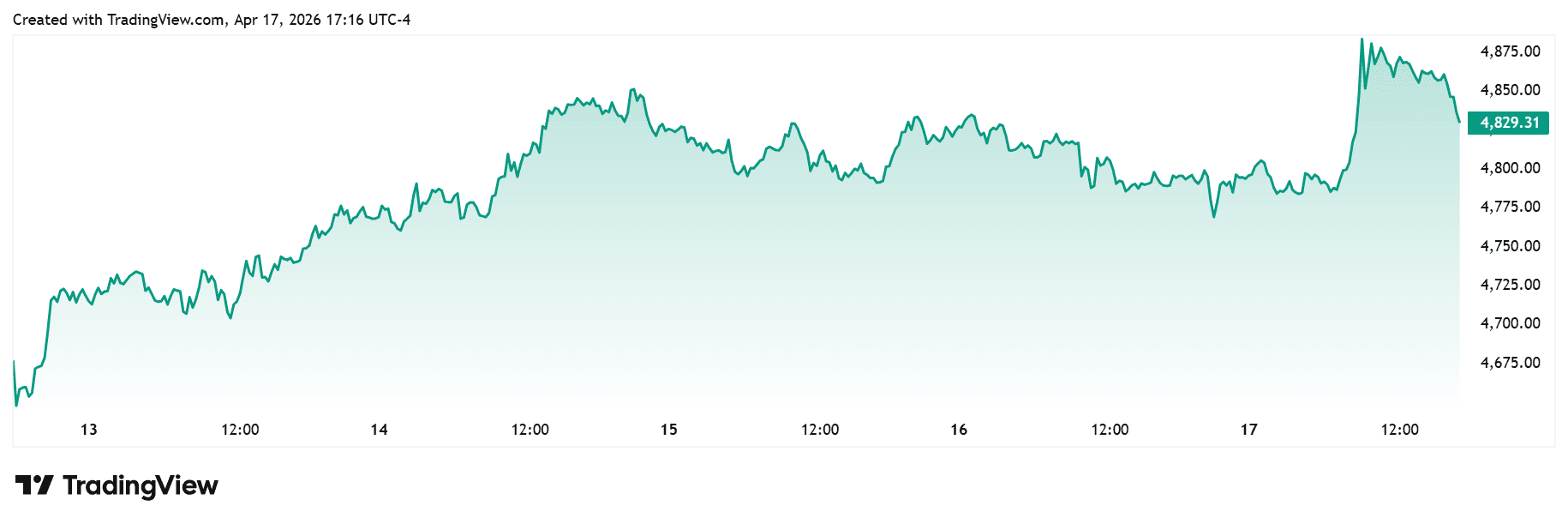
Spot gold kicked off the week trading at $4,676.77 per ounce, and after a quick dip down to set the weekly low near $4,645, the yellow metal embarked on a steady upward climb. By 9:00 p.m. Sunday evening, spot gold was already trading above $4,715 per ounce and after establishing firm support at $4,700 during Monday's North American session, Asian and European traders pushed the yellow metal all the way to $4,790 per ounce by 3:00 a.m. Tuesday morning.
By the time North American traders were at their desks on Tuesday, $4,770 had been established as firm near-term support, and by 11:15 a.m. Eastern, gold prices had broken smoothly through $4,800 per ounce, and by 9:15 p.m. the yellow metal set a midweek high above $4,850 per ounce that would hold until Friday morning’s dramatic Middle East developments.
In the near term, however, it was time for gold to retest support at $4,800, which it did late in the European session. Now the yellow metal would enter a prolonged period of consolidation, trading between $4,790 and $4,835 through Wednesday and Thursday trading.
The big move began just after 8:00 a.m. Eastern Friday morning as rumors began to circulate of positive developments in the Middle East. Spot gold then saw its most dramatic price action of the week, rising from the day’s low of $4,786 at 7:00 a.m. Eastern all the way to a high above $4,890 just after 9:00 a.m.
The move coincided with Iran's 8:45 a.m. announcement that the strait of Hormuz was completely reopened following the ceasefire between Israel and Lebanon, followed soon after by U.S. President Donald Trump's 9:05 a.m. Truth Social post confirming the deal.
But while spot gold executed multiple successful retests of support near $4,850 per ounce throughout Friday's trading session, it was unable to breach the $4,900 level, and half an hour before the equity close, traders took profits, with spot gold closing out the week trading at $4,829 per ounce.
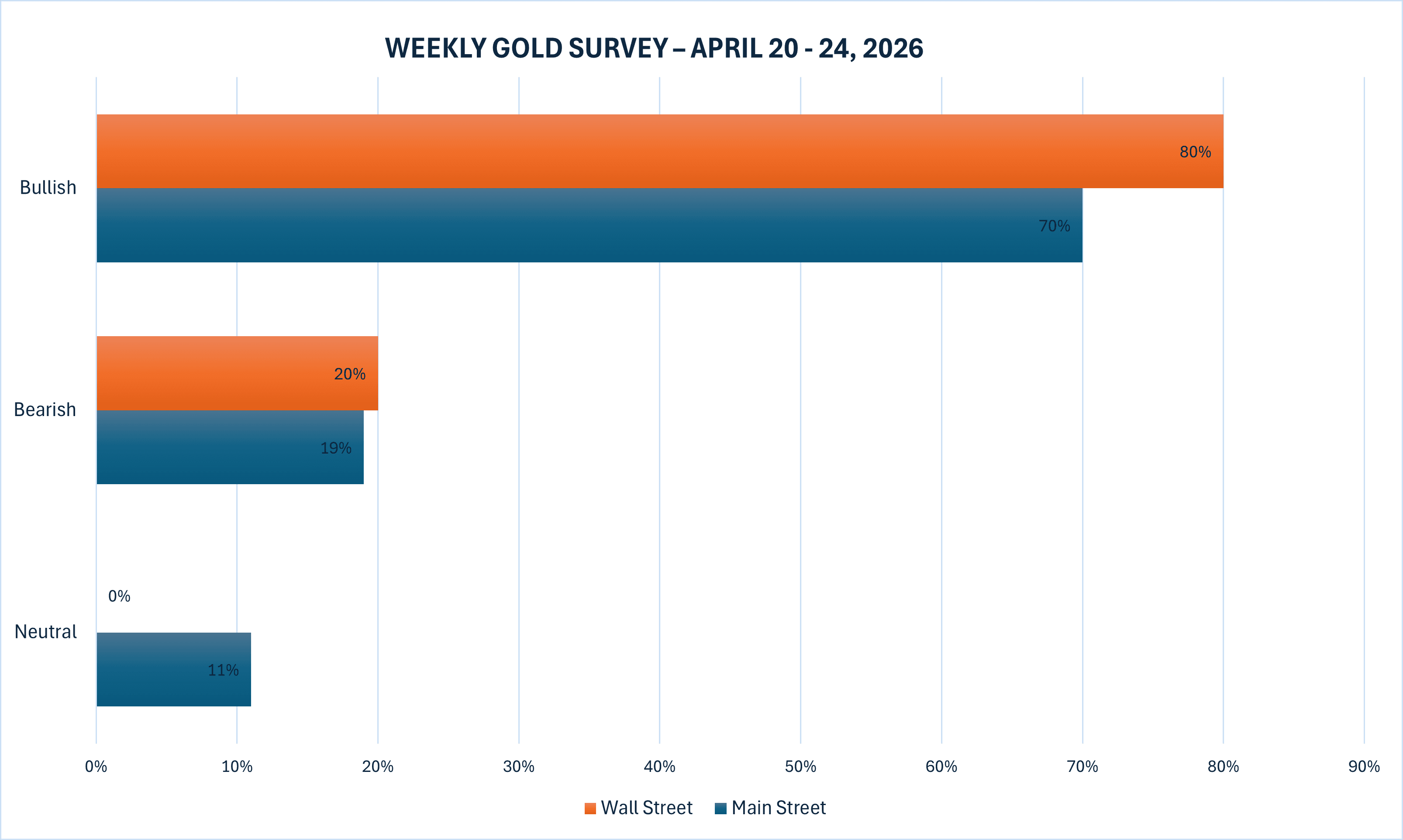
The latest Kitco News Weekly Gold Survey showed Wall Street and Main Street firmly back in bullish territory after the fourth straight week of gains for gold and renewed optimism that a long-term resolution to the Iran war may be within reach.
“Up,” said Rich Checkan, president and COO of Asset Strategies International. “Lately, gold and silver have been benefiting from cooler heads prevailing in the Middle East… moving up with ceasefires and moving down with open hostilities. As long as the fragile ceasefires last between the U.S. and Iran and between Israel and Lebanon, gold and silver should continue rebounding from their recent corrections.”
“Down,” said Darin Newsom, senior market analyst at Barchart.com. “Why? Since I have no idea, let’s apply generally useless technical analysis to the situation. The June contract is running up against its 50-day moving average of $4,938.50. The futures contract has not been above this technical momentum indicator since March 18. On the other hand, it hasn’t tested the 50-day until recently either. Another momentum indicator, daily stochastics, shows June gold to be overbought with readings near or above 90%.”
“Does any of this actually mean anything? Absolutely not,” Newsom added. “We’ll see what weekend social media posts and headlines bring.”
Daniel Pavilonis, senior commodities broker at RJO Futures, was looking at the impact of the Strait’s reopening on equities, bonds, and energy to gauge its likely impact on gold going forward.
“When we look at the paper market versus the physical market in energies, the physical prices were higher for much longer than the paper,” he told Kitco News. “I think a big part of that was the volatility washed out a lot of trading in the futures market over the course of eight weeks, or however long this has been going on.
“It was an easy trade in the beginning, but then when you see $15 swings both ways, it washes a lot of people out, and it really just leaves you with the hedgers, or some very under-leveraged traders that are still picking a side in the market,” he said. “We are trading the future price of that market, and May is trading down pretty big today, June is trading down, the whole curve is starting to narrow, going all the way till June of next year. It looks like the market is anticipating normalization.”
Pavilonis said the other key signal is coming from the Treasury market. “I think the biggest tell is the 10-year yield,” he said. “The yields were going up and now they're dropping. Stocks had a massive break to the upside, but I think that also correlates with the volatility in energy, which also washed out a lot of the shorts in the market, so it seems like a short-cover rally turn into a rally where people want to come in and buy.”
“We didn't see a big V-bottom in the metals, and I think we're seeing a relief rally right now,” Pavilonis said. “It's just hard to tell if we're going to continue to make new highs in gold and silver – I think we're definitely seeing a retracement – but it doesn't seem as strong as equities. That may not mean anything right now, it's just a little too early to tell. But so far, the markets across the board are risk-on.”
Pavilonis said the precious metals are likely to take a backseat to equities in the early going, but money could flow back into gold and silver if risk-on sentiment continues.
“I think gold is not at the forefront that it was in terms of interest in getting long; I think right now the main focus is on stocks,” he said. “Gold is still there, but it's more in the shadow of the stock market right now. As it comes out of the shadows over the next couple of weeks or so, I think you would see more interest, but I think that's not the first thing that people want to come in and buy.”
This week, 10 analysts participated in the Kitco News Gold Survey, with the overwhelming majority of Wall Street analysts predicting the regional ceasefire would result in gains for gold. Eight experts, or 80%, expected to see gold prices move higher during the week ahead, while two others, representing 20%, predicted a price decline. None called for consolidation during the week ahead.
Meanwhile, 47 votes were cast in Kitco’s online poll, with Main Street investor sentiment also improving with peace prospects. 33 retail traders, or 70%, looked for gold prices to rise next week, while another 9, or 19%, predicted the yellow metal would lose ground. The remaining 5 investors, representing 11% of the total, expected gold prices to trend sideways next week.
The week ahead is not a busy one for economic news releases, but with the Middle East conflict taking a long-awaited breather, markets may be ready to refocus their attention on domestic data that could shape expectations for Federal Reserve policy and, in turn, the direction of precious metals.
The week begins with the Tuesday morning release of U.S. retail sales for March, with many analysts pricing in some weakening after the surprising recent strength. Attention will then turn to pending home sales for March, which will shed light on the interest-rate-sensitive housing sector.
The Senate confirmation hearing for Kevin Warsh to become the new Federal Reserve chair is also scheduled for Tuesday, though Democrats are still pushing to delay the hearing, citing the ongoing DOJ investigation into current Fed officials. Warsh is expected to sound dovish notes on monetary policy, which would be supportive of higher gold prices.
Thursday morning's weekly jobless claims report will provide the week’s only insight into the labor market, which analysts have characterized as being in a “low-hire, low-fire” phase, with claims staying remarkably low by historical standards, after which traders will be watching the Flash S&P Global Composite PMI for April, a key real-time gauge of economic activity.
The week will close out with the final reading of the University of Michigan’s consumer sentiment survey for April, with investors looking to see if sentiment has deteriorated further since the start of the Iran conflict.
“I like gold higher in the week ahead as status quo ante returns,” said Marc Chandler, managing director at Bannockburn Global Forex. “Central bank selling can recede and with buying continuing (China and Poland, e.g.). Resistance near $5000. Momentum indicators constructive. Continues to trade more like risk asset than a safe haven for geopolitical maelstrom or inflation proxy.”
Adam Button, head of currency strategy at Forexlive.com, was looking at gold’s performance in the wake of the reopening of the Strait of Hormuz.
“Gold is a peace trade, and we're seeing it today,” Button said. “There were two things that really weighed on it in the war: de-leveraging, because it was a crowded long and all the crowded longs in everything got sold down, and two, emerging markets selling. Any emerging market that had gold reserves and had big oil imports had a currency at risk, and they were selling gold to protect those currencies – or if not, just to buy the oil, or to balance things out."
"Had oil stayed at $150, we would've had currency crises in emerging markets, and others would have been forced to sell gold reserves to stabilize their currency," he added. "I think some of them did; Turkey was selling. It looks like the risk of that has passed now.”
“But having said that, what are you left with here?” he asked rhetorically. “Let's say this war is over… what's really changed? What you have is this newly identified risk. The regime's still in power in Iran, Trump's still in power in the U.S., Bibi's still in power in Israel, and Hezbollah is still in Lebanon. None of the actors have changed here, and I don't know if anyone's learned a lesson.”
“Say you are one of those emerging market countries, now what are you going to do? You're going to need to build even bigger gold reserves in case this happens again,” Button said. “You're going to need to build oil reserves. Everyone's going to be building larger oil reserves, and other reserves: fertilizer, fuel. But gold is that fungible asset that, in the absence of hoarding whatever it is, you don't know if you're going to need computer chips or masks, like COVID or whatever else.”
“But if you have gold, you can get it.”
“I think gold ends up being a winner, and you see the momentum now,” he said. “I think there was physical selling at the start, and now we get the dollars into gold, probably on our way to $5,000.”
“Gold is not the ‘flavor du jour’ anymore, like it was in January when all anyone could talk about was gold,” Button added. “We're getting a hearing from [Fed chair nominee Kevin] Warsh on the 21st, so that's the thing I'd circle on my calendar. He's going to be dovish because he needs to be dovish so his nomination doesn't get pulled, and the market may take that at face value."
"I think that he'll come out and be dovish, and you'd rather be long gold during that.”
Alex Kuptsikevich, senior market analyst at FxPro, expects gold prices to decline next week.
“Gold is slowly but surely recouping its losses and has touched an area near $4900, where the 50-day MA is also located,” he said. “This was in response to signals of de-escalation between the US and Iran. This will curb inflation and dampen central banks’ appetite for tightening monetary policy. Fears on this front led to a decline in gold prices during the Middle East conflict. The precious metal will be supported by uncertainty over White House policy and the associated decline in confidence in the US dollar.”
“However, markets should now exercise caution due to the potential ‘buy the rumour, sell the fact’ reaction,” Kuptsikevich warned. “Although the gold market has maintained its upward trend, the pace of growth has slowed.”
“Next week, we will be closely monitoring developments around the 50-day moving average,” he added. “A rise above 4900 will raise the prospect of a move towards the 5300 level in the coming weeks. A sell-off from this level (our preferred scenario) would confirm a break in the upward trend.”
Michael Moor, founder of Moor Analytics, expects to see higher gold prices next week, but warned that prices could retrace if they hit near-term upside targets.
“Higher, unless we take out lower timeframe formations mentioned below,” he said. “HOWEVER, we are likely in the last stretch up from the March low and approaching possible exhaustion areas.”
“In a Higher time frame: I cautioned on 8/16/18 the break above $1,183.0 warned of renewed strength,” Moor said. “We have seen $4,443.1. This is ON HOLD. We held exhaustion at 56192 with a 56268 high and rolled over $1,526.8. This is ON HOLD. On a medium timeframe basis: The trade below 52554 (+15 tics per/hour) projects this down $220 minimum, $740 (+) maximum—we attained $1,155.4. The trade back below 52036 (+13 per/hour) has brought in $1,103.6 of pressure. The trade back below 51606 (+13 per/hour) has brought in $1,060.6 of pressure. The trade below 48530 (+4 tics per/hour) has brought in $753.0 of pressure. These are ON HOLD. We held exhaustion at 40956 with a 41000 low and have rallied $788.0. The trade above 41814 (-1 tic per/hour) has brought in $706.6 of strength. The trade above 43642 has brought in $523.8 of strength. The trade above 47119 (-12 tics per/hour) projects this upward $155 minimum, $790 (+) maximum—we attained $176.1 so far. These are OFF HOLD.”
“On a lower timeframe basis: I warned the break above 48133 (-14 tics per/hour at 8:20am) should bring in decent strength--we have attained $104.4 so far,” Moor wrote. “I would CAUTION we may be in the last stretch up from the 41285 low, with areas of possible exhaustion at 49161-587, 50499-954, and higher--if we hold one of these and roll over into a bearish correction, it should exceed $262 down from whatever the high is. Decent trade below 48081 (+3 tics per/hour starting at 11:20am) will project this down $114 minimum, $418 (+) maximum; but if we break below here decently and back above decently, look for decent short covering. A 'decent' penetration is $27.5 today.”
And Kitco senior analyst Jim Wyckoff is bullish on the pr0spects for gold and silver as the prospects for peace in the Middle East improves.
“Technically, June gold futures bulls’ next upside price objective is to produce a close above solid resistance at $5,000.00,” Wyckoff said. “Bears' next near-term downside price objective is pushing futures prices below solid technical support at $4,500.00. First resistance is seen at this week’s high of $4,895.40 and then at $4,950.00. First support is seen at $4,750.00 and then at $4,700.00. Wyckoff's Market Rating: 6.5.”
At the time of writing, spot gold last traded at $4,829.31 per ounce for a gain of 1.31% on the week and 0.84% on the day.