
Russia has already sold 22 tonnes of gold this year amid declining ruble, rising deficits
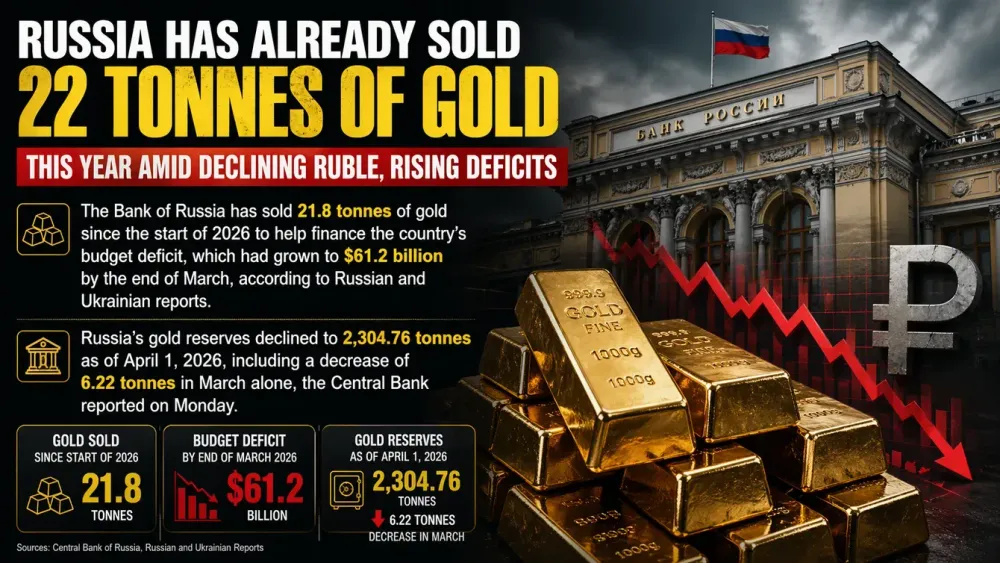
The Bank of Russia has sold 21.8 tonnes of gold since the start of 2026 to help finance the country’s budget deficit, which had grown to $61.2 billion by the end of March, according to Russian and Ukrainian reports.
Russia’s gold reserves declined to 2,304.76 tonnes as of April 1, 2026, including a decrease of 6.22 tonnes in March alone, the Central Bank reported on Monday.
Domestic demand for gold within Russia has skyrocketed as the country’s economy struggles in the fifth year of its war with Ukraine. According to the Moscow Exchange, the volume of gold transactions last month was up more than 350% compared to March of 2025, reaching 42.6 tonnes – 28.6 tonnes in swap transactions and 14 tonnes in spot transactions. With the ruble’s decline, the increase was even more dramatic: a 500% increase from the prior year, reaching 534.4 billion rubles, or $7.1 billion.
“Sales to finance the budget deficit may continue amid a sharp increase in government spending compared to budget targets,” said Natalia Milchakova, lead analyst at Freedom Finance Global, in a comment to Reuters. “Such sales of gold from reserves by the Central Bank of Russia are entirely consistent with what other central banks are doing, especially in developing countries.”
Russia’s gold reserves were built up primarily between 2002 and 2025, when they purchased over 1,900 tons of gold, buying just over 500 tonnes between 2008 and 2012, and 1,200 tonnes between 2014 and 2019. According to Finam analyst Nikolai Dudchenko, Russia’s net gold purchases have amounted to only 55.4 tons since 2020.
“Currently, a number of central banks continue to sell gold due to the need to cover expenses, including defense costs,” Dudchenko said, adding that the money is also used to cover “rising energy prices and to support national currency exchange rates.”
On Feb. 20, Russia’s central bank announced they had sold 300,000 ounces of gold from its reserves in January as prices hit record highs above $5,500 per ounce, lowering its total holdings to 74.5 million ounces. This was the first decrease in Russia’s gold reserves since October.
Gold prices averaged roughly $4,700 per ounce in January, but peaked at $5,600 per ounce, so the bullion sales likely brought in somewhere between $1.41 billion and $1.68 billion.
Even with the sale, the value of Russia’s gold reserves rose 23% in January to $402.7 billion as prices shot to record highs.
In July, Bloomberg reported that Russia’s precious metals exports to China nearly doubled in value during the first half of 2025.
“Chinese imports of Russian precious metal ores and concentrates, including gold and silver, jumped 80% to $1 billion from the same period a year earlier,” Bloomberg reported at the time, citing data from Trade Data Monitor and China’s customs office. “Bullion prices have climbed about 28% this year, boosted by heightened geopolitical risks and trade tensions, alongside buying by central banks and exchange-traded funds.”
Russia is the world’s number-two gold producer – second only to China – with an annual output of over 300 tonnes. Russia’s central bank was also one of the world’s biggest sovereign gold buyers, but its purchases have fallen off since the full-scale invasion of Ukraine in 2022. The People’s Bank of China continues to be among the leading central bank buyers in recent years.
Russia’s gold exports to China are up in volume terms, but much of the difference is also due to the gold price rally over the last 12 months, with spot prices rising nearly 43% over the last 12 months.
The country’s gold miners are also supporting rising domestic retail demand, which hit a record high last year as Russians clamored for precious metals to protect the value of their savings. Russian consumers purchased 75.6 tonnes of gold in 2024, representing approximately 25% of the country’s annual production.
The more recent rally in other precious metals has also boosted revenues among Russia’s top miners. “MMC Norilsk Nickel PJSC, one of the world’s top producers of palladium and platinum, has ramped up exports to China this year,” the report noted. “Prices for the two metals jumped 38% and 59%, respectively [in 2025].”