Vertex Minerals advances mechanised mining with first longhole stope blast at Australian gold mine
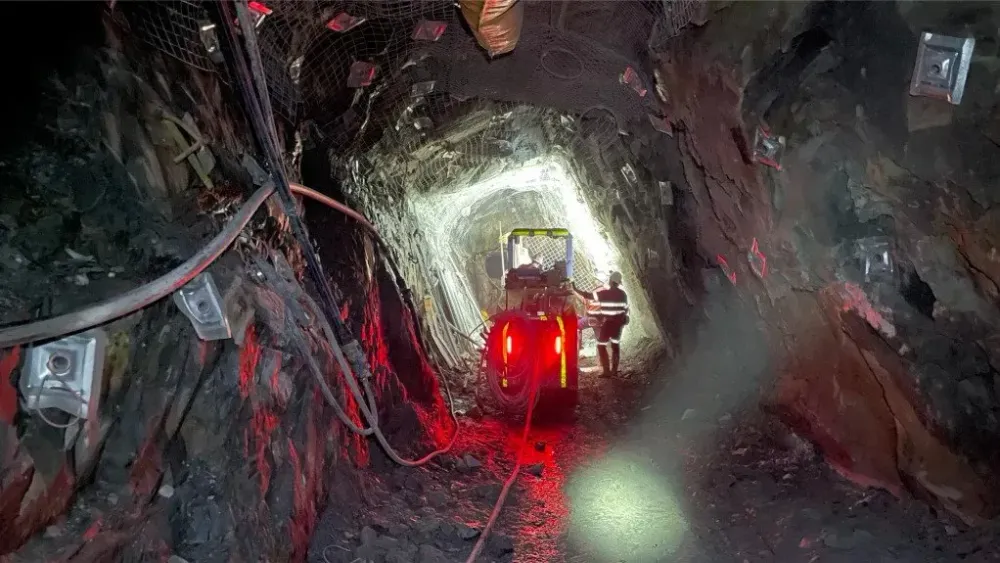
ASX-listed Vertex Minerals has announced the first production firing of its trial longhole open stope at Decline 3 at the Reward gold mine, in New South Wales, Australia.
SX-listed Vertex Minerals has announced the first production firing of its trial longhole open stope at Decline 3 at the Reward gold mine, in New South Wales, Australia.
Vertex highlights that the initial production screening of ore from the trial stope returned high-grade quartz with visible gold, consistent with the company’s expectations for the Mica 1 lens and a diluted head grade to the plant from the 1 200 t stope is expected to be about 8 g/t of gold.
The trial stope comprises an 8 m airleg slot rise with the first longhole rings of the stope now having been successfully fired, and the stope has been designed to a mining width of about 1.2 m, which is consistent with Vertex’s existing airleg stoping widths, allowing management to directly compare productivity, cost and dilution outcomes between the two mining methods as the trial progresses.
At this width, the company says, this stope is believed to be among the narrowest mechanised longhole stopes mined in Australia to date.
Vertex also notes that the stope was developed from the base of Decline 3 and marks the start of a bottom-up mining sequence at the Reward mine.
The company adds that this follows substantial rehabilitation of the historic decline network, where mining at a 4 m width had previously proven highly dilutive. However, the company says the stope design now represents the culmination of six months of detailed geological and engineering planning by the Vertex team.
“This is a pivotal moment in the Reward mine’s evolution. Moving to narrow longhole stoping means we’re mining our very narrow, high-grade veins with the least amount of dilution, which provide significantly higher feed grade to the plant. This major step is an important proof of concept for the team and the project as we work towards full mechanised longhole open stoping at Reward.
“While more improvements can be made with a dedicated Muki rig drilling more accurate holes, it shows what our underground crews are capable of and gives us real operating data to plan the wider rollout of longhole mining as we develop the growth of gold production at the Reward mine,” comments Vertex operations executive director Jim Simpson.
He also reflects that the development work required to reach and mine this first stope at the base of Decline 3 has taken longer than originally planned as the primary cause of the delay had been the ground conditions encountered in the declines and around the stope areas.
This ground, Simpson continues, had been inundated for about 14 years prior to dewatering and, once exposed, was found to be in poor condition and unsafe to work in.
Consistent with Vertex’s commitment to safe work practices, the underground team undertook additional remediation across the affected areas, including stripping loose material from the backs, installing rock bolts and mesh and, in places, grouting cable anchors into the surrounding rock to secure the ground before mining could safely proceed, Simpson explains.
Ahead of the firing, Vertex’s underground team completed about 350 m of hanging wall cable bolt installation and 680 m of production drilling.
The company notes that the drilling was carried out using a modified jumbo drill rig as an interim solution, pending arrival of a dedicated Resemin Muki longhole production drill rig, with construction set for September.
Once completed, the drill rig will be shipped to Australia, after which it will be commissioned to support mechanised longhole production drilling across the Reward underground mine.
Simpson concludes that this trial forms an important step in Vertex’s strategy to transition progressively from airleg to mechanised longhole open stope mining as the mine matures and additional levels are established below Decline 3, with the objective of improving productivity and unit costs and reducing dilution relative to conventional airleg mining methods.