ARRAS MINERALS MOBILIZES TWO ADDITIONAL DRILLS TO THE ELEMES PROJECT FOR TOP-OF-BEDROCK (KGK) PROGRAM IN KAZAKHSTAN AND FILES NI 43-101 TECHNICAL REPORT ON THE ELEMES PROJECT
Vancouver, British Columbia – Arras Minerals Corp. (TSX-V: ARK, OTCQB: ARRKF) (“Arras” or the “Company”) is pleased to announce the commencement of a top-of-bedrock (“KGK”) drilling program at its Elemes Project in northeastern Kazakhstan, advancing what is emerging as a district-scale copper-gold system.
Program Highlights:
Approximately 5,000 metres of drilling planned to evaluate the Berezski Trend
Approximately 1,000 metres of drilling planned to test the core of the 14 km Aimandai geochemical anomaly located approximately 7 km east of the Berezski Trend
Program designed to delineate the extent of known mineralization under shallow cover and test for additional porphyry centres
Late last year, the Company completed a 64-hole KGK program that expanded the footprint under shallow cover of copper-gold mineralization at Berezski Central and Berezski East to over 1,000 metres of strike length. Mineralization remains open to the north and south, highlighting the potential for significant expansion of mineralization along this highly prospective corridor.
Burstroy Drilling has been engaged to conduct approximately 6,000m of KGK drilling that has been designed to rapidly evaluate the Berezski and Aimandai trends and prioritize targets for diamond drilling over the next few months.
Tim Barry, CEO of Arras Minerals, commented: “In late 2025, we tested a section of the Berezski Trend with KGK-drilling that expanded the footprint of the Berezski Central and Berezski East targets and identified additional exploration targets. This top-of-bedrock drilling has proven to be a great tool to quickly prioritize targets for diamond-drill testing over large areas with shallow cover masking the geology. Given the success in the initial program, we are focusing on Berezski East and further along strike north and south from Berezski Central in this emerging large-scale corridor. Additionally, at Aimandai, we’re targeting the core of the 14 km soil anomaly to identify targets for follow-up initial diamond-drilling.”
Top-of-Bedrock (KGK) Drilling at Berezski
In December 2025, the Company announced results from a 64-hole KGK drilling program across Berezski Central and Berezski East, materially advancing the understanding of geology and Cu-Au mineralization beneath shallow cover. The program not only expanded the known footprint, but demonstrated that KGK drilling is a rapid, scalable method for vectoring along the 8.8 km Berezski Trend and for targeting additional mineralized centres.
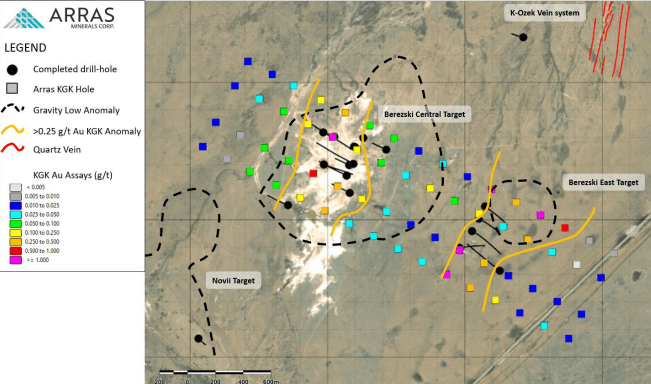
Figure 1. Berezski Central and Berezski East Targets showing 2025 KGK drill-holes Au values.
In 2026, approximately 200 KGK drill holes are planned along the Berezski Trend to unlock the broader potential of the system. Drilling will focus on:
Evaluating the large, demagnetized corridor between Berezski Central and Berezski North, interpreted to reflect magnetite-destructive alteration associated with porphyry-style mineralization.
Advancing exploration of the Berezski East gold zone, coincident with a linear magnetic high interpreted to represent stockwork magnetite–quartz–chalcopyrite veining associated with gold mineralization.
Testing the footprint of gold mineralization identified during the 2025 KGK program within the magnetic low immediately east of the Berezski East target, to determine whether it is related to Berezski East mineralization or represents additional new gold zones.
Expanding the Berezski Central target southward toward the Novii porphyry target.
This program is designed to materially increase the scale and continuity of mineralization and generate high-priority diamond-drill targets.
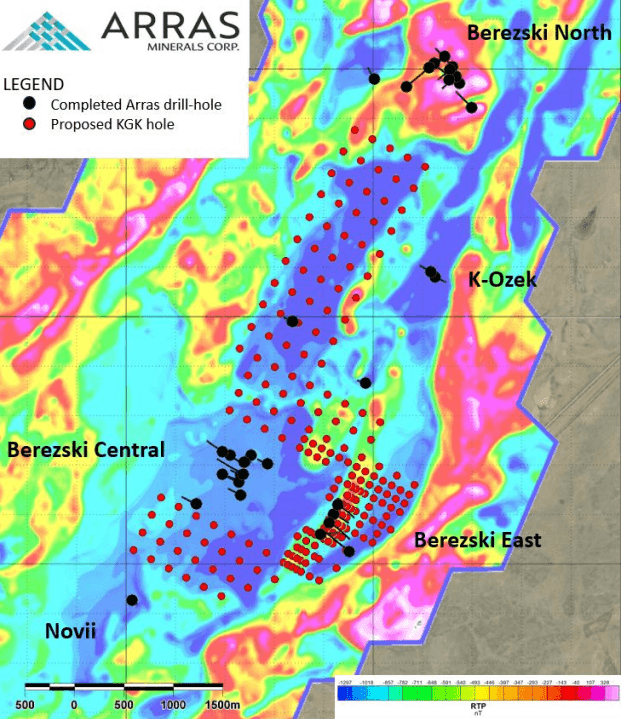
Figure 2. Berezski Trend, showing completed drill-holes, proposed KGK holes, overlain on reduction to pole (“RTP”) ground magnetic
survey data.
Top of Bedrock (KGK) Drilling at Aimandai
In 2024, the Company completed a property-wide soil sampling program that identified a large, previously unexplored 14 km by 3.2 km NE-SW trending copper (“Cu”) and arsenic (“As”) anomaly in the eastern portion of the property. The anomaly is interpreted as indicative of an intermediate- to high-sulphidation epithermal system, potentially overlying a preserved porphyry system. Field mapping and sampling confirmed the presence of coincident altered rocks characteristic of a porphyry alteration system.
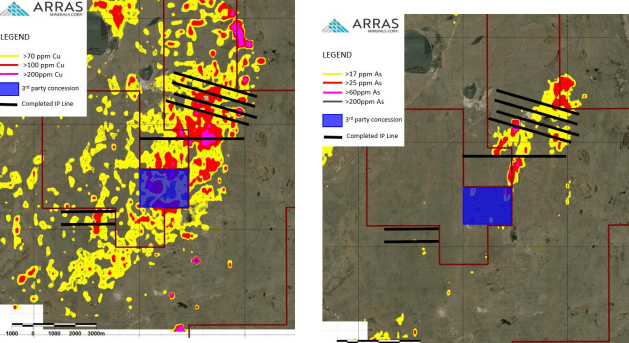
Figure 3. Aimandai soil Cu and As pXRF anomalies.
A 64.4 square-kilometre ground magnetic survey and a 7-line, 21.6 line-kilometre Induced Polarization (IP) survey over the Aimandai Target has subsequently been completed. The IP survey identified multiple chargeability anomalies that may be associated with disseminated sulphide mineralization. These anomalies are spatially coincident with resistivity lows, potentially indicating structurally controlled hydrothermal alteration zones. The anomalies exhibit consistent NNE–SSW and NW–SE structural trends.
The ground magnetic survey identified several discrete magnetic highs interpreted to be associated with intrusive rocks. The results have enabled the Company to further refine the structural framework of the Aimandai Target and prioritize areas for follow-up exploration.
The Company is plans to drill 50 KGK holes to systematically explore the core of the Aimandai anomaly. The program is designed to rapidly evaluate the anomaly, determine its origin, and define priority targets for follow-up diamond drilling.
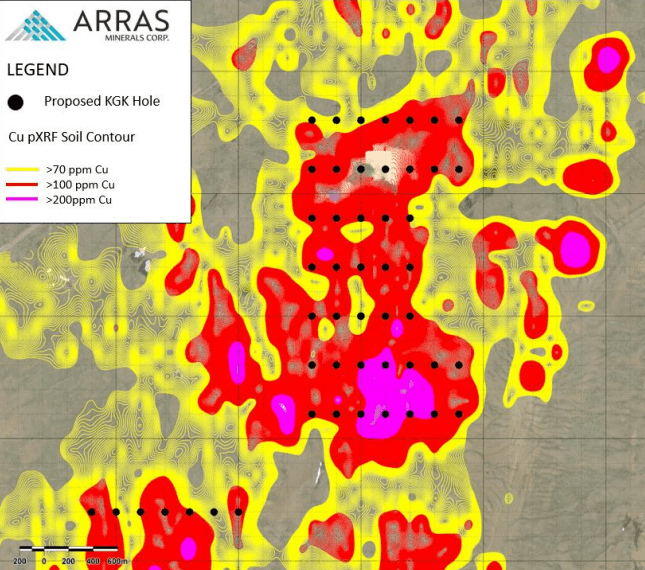
Figure 4. Aimandai Trend showing proposed KGK holes overlain on core Aimandai pXRF soil anomaly.
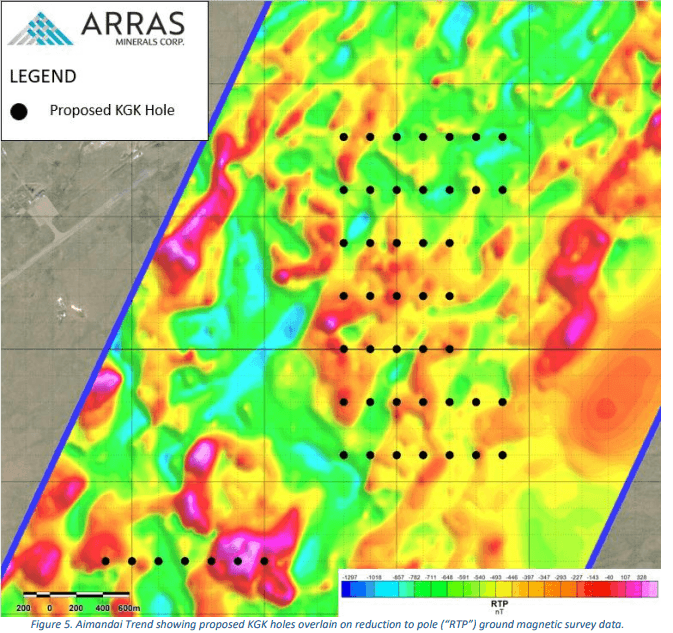
Figure 5. Aimandai Trend showing proposed KGK holes overlain on reduction to pole (“RTP”) ground magnetic survey data.
Exploration Update
Four diamond drill rigs are currently operating at Elemes with nearly 7,000m drilled since activities recommenced in February. Two holes have been completed at Berezski East, 7 holes have been completed at Berezski North and a single hole on the K-Ozek target, which is testing a series of epithermal gold veins mapped and sampled over a 2 km strike length.
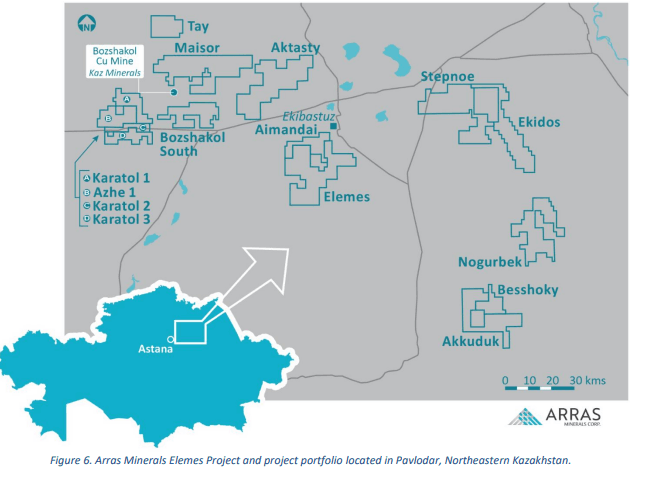
Figure 6. Arras Minerals Elemes Project and project portfolio located in Pavlodar, Northeastern Kazakhstan.
Elemes Phase II Drill Program: Since June of last year, Arras Minerals has been advancing its 20,000m Phase II diamond drill program at the Elemes Project. Drilling was paused in late December for a scheduled winter break and recommenced in February. Nearly 10,000m were completed in 2025, and the strength of the results has prompted Arras to plan an expansion of the program to 30,000m, with completion targeted by the end of 2026.
Elemes Project Overview: The Elemes Project comprises two exploration licenses covering 531 square kilometres in northeast Kazakhstan, located approximately 13 km southwest of Ekibastuz and just 20 km from Arras’s operational base. The project benefits from exceptional infrastructure, with a paved highway crossing the licence, and access to 1,100 KVA power lines, heavy rail, and other utilities within a 15 km radius.
Situated within the prolific Bozshakol-Chingiz metallogenic belt, Elemes lies near significant regional deposits, including the Beskauga porphyry copper-gold-silver deposit (~80 km east) and KAZ Minerals’ Bozshakol copper-gold mine (~60 km northwest), which reported mined grades in Q1 2025 of 0.37% copper and 0.20 g/t gold. 1
Geologically, the property is underlain by interbedded intermediate volcanic and sedimentary rocks intruded by multiple phases of diorite and monzodiorite porphyry. Copper-gold mineralization occurs in sheeted and stockwork quartz-chalcopyrite veins associated with these intrusions. In addition, high- grade low-sulphidation epithermal veins have been mapped on the property, representing a secondary exploration target.
Property-wide soil sampling programs defined two extensive Cu-Mo-As geochemical anomalies: the Berezski and Aimandai Trends, both considered priority targets for follow-up exploration drilling. A Phase 1 drill program on the Berezski Trend in late 2024 returned high-grade porphyry/epithermal copper and gold mineralization in results announced in Q1 2025. A 20,000m Phase 2 drill program commenced in May 2025 which was expanded to 30,000 metres in January 2026 and is expected to be completed by the end of 2026.
A series of epithermal quartz veins have been mapped and sampled over a 2km strike length at the K- Ozek target that is running along the eastern margin of the Berezski Trend. The Company is planning to drill several holes into this target to test its potential.
Elemes Project NI 43-101 Report: Arras is also pleased to announce it has filed a National Instrument 43-101 Technical Report for the Elemes copper-gold project. The Technical Report was prepared for the Company by Trevor Wright, M.Sc., who is a “Qualified Person” (within the meaning of NI 43-101) and independent of Arras (within the meaning of Section 1.5 of NI 43-101). The Technical Report highlights Elemes as a large, gold-rich copper-gold porphyry and epithermal system within the Bozshakol-Chingiz metallogenic belt and covers multiple target areas along the Berezski mineralized trend, including Berezski Central, Berezski East, Berezski North, K-Ozek and Novii.
Issuance of DSUs: The Company has granted an aggregate of 48,217 deferred share units ("DSU") to certain independent directors at a price of C$0.78 per DSU. The DSUs were granted in consideration for services rendered by the directors for the quarter ended April 30, 2026, in lieu of cash. The DSUs were granted in accordance with the Company's Equity Incentive Plan and were priced based on the volume weighted average price of the Company's common shares on the TSX Venture Exchange for the last five trading days immediately preceding the grant date. To date, the Company has issued a total of 206,755 DSUs to its independent directors.
References
1Bozshakol Q1, 2025 Report
https://kazminerals.com/app/uploads/2025/12/q3-2025-production-report_final.pdf
Quality Assurance and Quality Control
The Company adheres to CIM Best Practices Guidelines for exploration related activities conducted on its property. Quality Assurance and Quality Control (QA/QC) procedures are overseen by the Qualified Person.
Arras Minerals QA/QC protocols are maintained through the insertion of certified reference material (standards), blanks and field duplicates within the sample stream. Drill core is cut at Arras Minerals operations base in Ekibastuz, Kazakhstan by Company personnel. Diamond drill core was sawed in- half with a diamond saw, and then sampled in maximum 2-meter intervals, stopping at geological boundaries, with one-half placed in sealed bags and shipped to the laboratory and the other half retained on site.
Each bagged core sample was shipped to ALS Laboratory in Karaganda, Kazakhstan. Samples were dried, crushed and pulverized to >80% passing -200 mesh. The prepared sample splits were sent to the ALS Chemex’s geochemical analysis laboratories laboratory in Loughrea, County Galway, Ireland and Lima, Peru for multi-element analysis. Multielement analyses were analyzed with ICP-MS following a four-acid digestion (method ME-MS61) and samples containing >1.0% copper are analyzed via method Cu-OG62.
Gold analysis was conducted by ALS Chemex at the analytical laboratory in Karaganda, Kazakhstan. Gold was analyzed by fire assay (30 g) with an AA (atomic absorption) finish (method Au-AA23) with detection limits of 0.005 g/t gold. Samples containing greater than 10.0 g/t gold are analyzed by fire assay with a gravimetric finish (method Au-GRA21).
ALS is an accredited laboratory which is independent of the Company. Chain of custody is maintained from the drill to the submittal into the laboratory preparation facility.
Qualified Person
The scientific and technical disclosure for this news release has been prepared under supervision of and approved by Matthew Booth, Vice President of Exploration, of Arras Minerals Corp., a Qualified Person for the purposes of NI 43-101. Mr. Booth has reviewed and approved this release. Mr. Booth has over 20 years of mineral exploration experience and is a Qualified Person member of the American Institute of Professional Geologists (CPG 12044).
On behalf of the Board of Directors,
"Tim Barry"
Tim Barry, MAusIMM CP(Geo)
Chief Executive Officer and Director
INVESTOR RELATIONS:
+1 604 687 5800
info@arrasminerals.com
Further information can be found on:
the Company’s website https://www.arrasminerals.com or
follow us on LinkedIn: https://www.linkedin.com/company/arrasminerals or
follow us on X (formerly Twitter): https://twitter.com/arrasminerals
About Arras Minerals Corp: Arras is a Canadian exploration and development company advancing a portfolio of copper and gold assets in northeastern Kazakhstan, including the Elemes copper-gold porphyry project where initial drill results in 2025 identified porphyry style mineralization across a 10 km line of strike. The Company has established one of the largest land packages in the country prospective for copper and gold. The Company’s shares are listed on the TSX-V under the trading symbol “ARK” and on the OTCQB under the trading symbol “ARRKF”.
Cautionary note regarding forward-looking statements: This news release contains forward-looking statements regarding future events and Arras’ future results that are subject to the safe harbors created under the U.S. Private Securities Litigation Reform Act of 1995, the Securities Act of 1933, as amended, and the Exchange Act, and applicable Canadian securities laws. Forward-looking statements include, among others, statements regarding plans and expectations of the exploration program Arras is in the process of undertaking, the timing, scope, nature, breadth and other information related to Arras’ exploration program, any results that may be derived from the Arras’ exploration program, the prospects of Arras’ business plans, and any expectations with respect to any permitting, development or other work that may be required to bring any of the projects into development or production. These statements are based on current expectations, estimates, forecasts, and projections about Arras’ exploration projects, the industry in which Arras operates and the beliefs and assumptions of Arras’ management. Words such as “expects,” “anticipates,” “targets,” “goals,” “projects,” “intends,” “plans,” “believes,” “seeks,” “estimates,” “continues,” “may,” variations of such words, and similar expressions and references to future periods, are intended to identify such forward-looking statements. Forward-looking statements are necessarily based upon a number of assumptions that, while considered reasonable by management at the time, are inherently subject to business, market and economic risks, uncertainties and contingencies that may cause actual results, performance or achievements to be materially different from those expressed or implied by forward-looking statements. Such assumptions include, but are not limited to, assumptions that the anticipated benefits of Arras’ proposed exploration program will be realized, that no additional permit or licenses will be required in connection with Arras’ exploration programs, the ability of Arras’ to complete its exploration activities as currently expected and on the current anticipated timelines, that Arras’ will be able to execute on its current plans, that Arras’ proposed explorations will yield results as expected, and that general business and economic conditions will not change in a material adverse manner. Although Arras has attempted to identify important factors that could cause actual results to differ materially from those contained in forward-looking information, there may be other factors that cause results not to be as anticipated, estimated or intended. There can be no assurance that such information will prove to be accurate, as actual results and future events could differ materially from those anticipated in such statements. Accordingly, readers should not place undue reliance on forward-looking information. Such statements represent the current view of Arras with respect to future events and are necessarily based upon a number of assumptions and estimates that, while considered reasonable by Arras, are inherently subject to significant business, economic, competitive, political and social risks, contingencies and uncertainties. Risks and uncertainties include, but are not limited to the following: inability of Arras to realize the benefits anticipated from the exploration and drilling targets described herein or elsewhere; inability of Arras to complete current exploration plans as presently anticipated or at all; inability for Arras to economically realize on the benefits, if any, derived from the exploration program; failure to complete business plans as it currently anticipated; overdiversification of Arras’ portfolio; failure to realize on benefits, if any, of a diversified portfolio; unanticipated changes in market price for Arras shares; changes to Arras’ current and future business and exploration plans and the strategic alternatives available thereto; growth prospects and outlook of the business of Arras; and the ability to advance Arras’ projects and its proposed exploration program; risks inherent in mineral exploration including risks related worker safety, weather and other natural occurrences, accidents, availability of personnel and equipment, and other factors; aboriginal title; failure to obtain regulatory and permitting approvals; no known mineral resources/reserves; reliance on key management and other personnel; competition; changes in laws and regulations; uninsurable risks; delays in governmental and other approvals, community relations; stock market conditions generally; demand, supply and pricing for uranium; and general economic and political conditions in Canada, Kazakhstan and other jurisdictions where Arras conducts business. Other factors which could materially affect such forward-looking information are described in the filings of Arras with the Canadian securities regulators which are available on Arras’ profile on SEDAR+ at www.sedarplus.ca. Readers are cautioned that forward-looking statements are not guarantees of future performance and that actual results or developments may differ materially from those expressed or implied in the
forward-looking statements. Any forward-looking statement made by Arras in this release is based only on information currently available and speaks only as of the date on which it is made. Arras undertakes no obligation to publicly update any forward-looking statement, whether written or oral, that may be made from time to time, whether as a result of new information, future developments, or otherwise.