
Global gold demand drives Canada’s trade into surplus, helps mitigate economic uncertainty
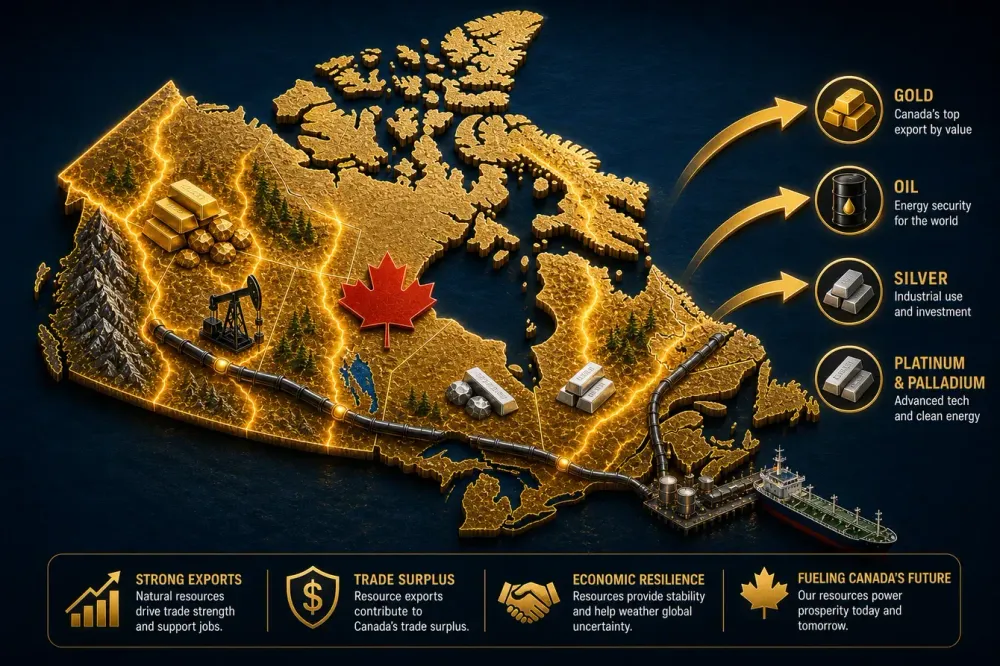
Despite ongoing trade tensions with the U.S. and growing global economic uncertainty due to the war in Iran, Canada’s resources are helping the country weather the worst of the storm.
Elevated gold prices and surging oil prices pushed Canada’s trade into surplus territory for the first time in six months.
According to trade data from Statistics Canada, an increase in exports and a decrease in imports resulted in a $1.8 billion trade surplus in March.
The report showed total exports increasing 8.5% to $72.8 billion in March, the highest level since January 2025. It was a sharp turnaround compared to the $5.1 billion trade deficit seen in February, the largest on record since August 2025.
At the same time, imports fell 1.6% after jumping in February; the decline was driven by consumer goods, which dropped 3.9%, while aircraft and other transport equipment declined 12.8%.
The report said that Canada’s trade surplus was driven in part by a 24% increase in precious metals demand. Exports of precious metals—gold, silver, and platinum—were the biggest contributor to the monthly change in this category, rising 37.7% to $3 billion, with most of the precious metals shipped to the United Kingdom.
At the same time, oil exports increased by around 15.6% to $17.1 billion in March—the highest level since September 2022. Canada is benefiting from a significant jump in global crude oil prices because of the energy market supply shock caused by the war in Iran.
Although Canada has been able to navigate America’s global trade war, economists note that there is still plenty of uncertainty ahead as Canada, Mexico, and the U.S. look to renegotiate their free trade agreement this summer.
“Significant trade uncertainty remains, with negotiations on CUSMA renewal likely to intensify in coming months, but we continue to expect, as a base case, that a more stable U.S. tariff backdrop in 2026 (albeit still at significantly higher tariff rates for some products) will leave trade as less of a headwind to growth than it was in 2025,” said economists from RBC. “The conflict in the Middle East is raising costs for households both in Canada and abroad, but the surge in net energy exports from higher oil prices is also significantly increasing revenues flowing into oil-producing regions. Our base-case outlook for the economy expects that, coupled with the lagged impact of earlier Bank of Canada interest rate cuts and higher government spending plans, will support further improvement in per-person (and per-worker) economic conditions in the year ahead.”
Shelly Kaushik, Senior Economist at BMO Capital Markets, said she also sees more economic uncertainty ahead.
“The March trade figures highlight Canada’s relative advantage as an energy supplier while the Strait remains closed. While that support will remain until the Middle East conflict is resolved, the pace of global non-energy demand and the future of the USMCA remain key sources of uncertainty,” she said.
While oil prices and energy have dominated global financial markets since the war in Iran started, analysts said they still see strong underlying demand for gold, particularly from central banks.
However, retail investment demand for gold has been dampened by higher oil prices, which are driving inflation fears and forcing central banks to shift to a neutral, wait-and-see stance on monetary policy.