
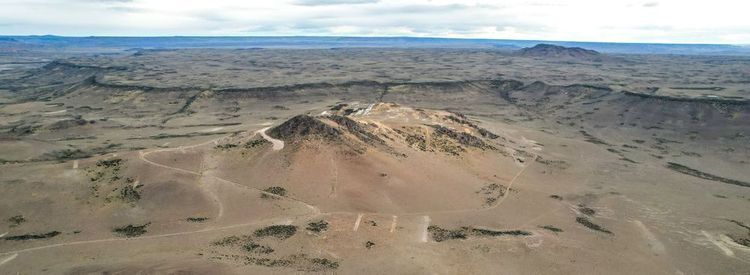
Astra’s CEO, Brian Miller commented:
“Astra has a unique portfolio of exploration properties in Argentina and Chile and recently has taken the opportunity to advance Don Mario to the drill stage. The combination of outcropping gold mineralization with a large alteration zone and overlapping geophysical and geochemical targets makes for a compelling large-scale HSE target in the Maricunga Belt – a belt known to produce several world-class gold mines. We intend to proceed and drill the project in the coming months with a 2,000 – 3,000 metre fully-funded program and are pleased to add this discovery opportunity to our large flagship La Manchuria drilling program.”
Astra’s Exploration Director, Diego Guido commented:
“The different exploration tools used at Don Mario have significantly improved our understanding of this large high sulphidation target, vectoring toward the prospective portions of the system. The distribution of the gold-silver surface anomalies into silicified diatreme breccias, together with the deeper resistive anomaly identified by the CS-NSAMT survey, suggests that the system may preserve both shallow disseminated mineralization and deeper feeder structures.”
Don Mario Exploration Results
The Company has received the results of a low-cost exploration program completed at the Don Mario Project (See NR 2026-05-30 Astra Provides Exploration Update and Receives Independent Analyst Coverage from ATB Cormark Capital Markets), located within the eastern Maricunga gold belt of northern Chile. The program included geological mapping of the property, a combined geochemical and spectral mineralogy survey and three Controlled and Natural Source Audiofrequency Magnetotelluric (CS-NSAMT) survey lines.
The results outline a 2 kilometre by 1 kilometre gold and silver geochemical target concentrated in the southwestern portion of a larger 2 kilometre by 2 kilometre lithocap within the 4,480 hectare property. Don Mario is located within the Maricunga gold belt, which is one of the most prolific gold districts in the world containing several large HSE and porphyry deposits.
Eight shallow RC holes were completed by previous operators and returned 20 metres and 32 metres of 0.41 g/t gold and 0.38 g/t gold respectively, in two separate holes. These holes were completed to the east of the current focus of exploration, and did not test Astra’s currently high-priority drill targets. Drill results by previous operators are historical in nature and have not been verified by Astra.
Geology of Don Mario project
Astra’s geological mapping of the Don Mario project (Figure 1) shows a strong overlapping 2 kilometre by 1.8 kilometre area of intense hydrothermal alteration identified from satellite imagery and the Cerro Bayo Volcanic Complex. The Complex includes a dacitic to rhyodacitic dome forming the Cerro Bayo hill in the northeast portion of the alteration anomaly, surrounded by phreatomagmatic tuffs exposed mainly to the west (Figure 1).
The Cerro Bayo Volcanic Complex is interpreted to continue westward beneath shallow modern cover, based on several subcrops and small outcrops identified along creeks in this area. Portions of the target geology are pervasively silicified and locally form vuggy silica and hydrothermal breccias cemented by quartz-alunite and jarosite. Previous exploration by other operators at the Project identified locally elevated gold values within some of these hydrothermal breccias.