
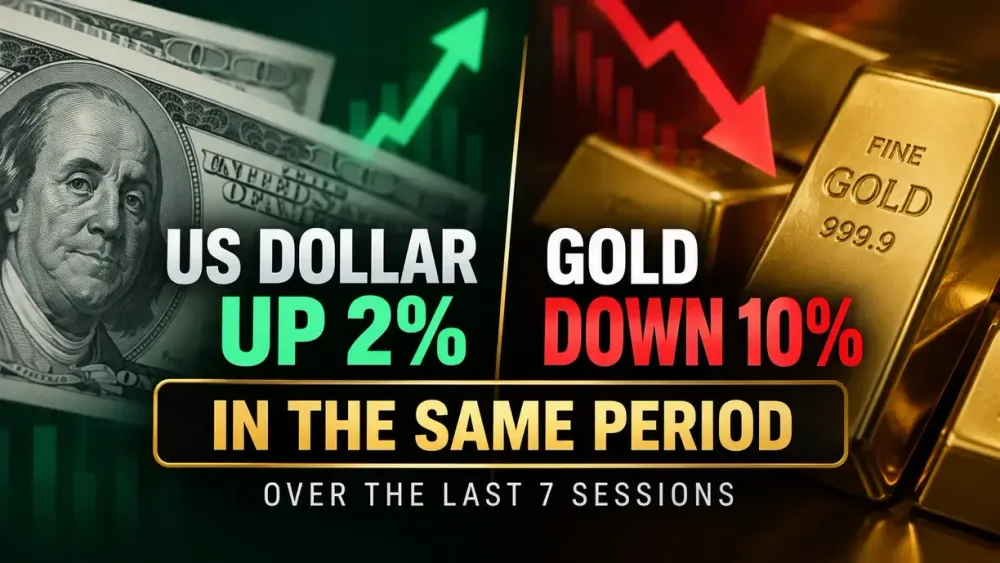
US dollar up 2% over last 7 sessions, gold down by 10% in the same period
Gold and silver opened the New York session with an attempt to recover the losses they had taken on in overseas trading. Between 8 and 9 AM ET, both gold and silver futures climbed more than 1%, but the rebound proved short-lived. By 9 AM, both metals had resumed their downward bias, and the release of the Fed minutes at 2 PM ET drove the final nail into the coffin for Wednesday's session, pushing gold and silver to fresh lows. Gold futures finished the day down 3.22%, while silver futures fell 4.90%.
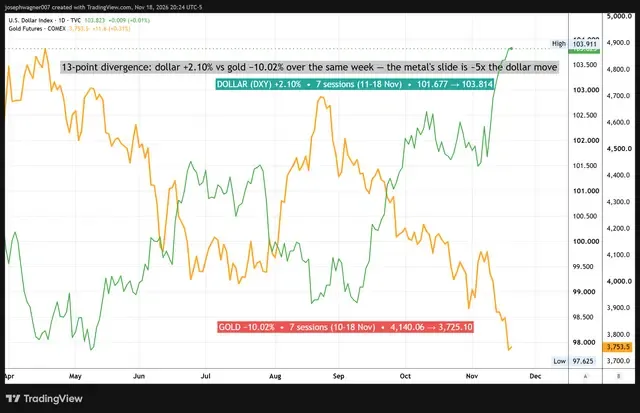
The October minutes revealed that some officials had opposed the decision to pause at the last meeting, and the release was broadly interpreted as hawkish. Several officials also favored a 50 basis point hike at the December meeting, and every member anticipated higher rates by the start of 2027. That message lifted the US dollar index for a seventh consecutive session, its first seven-day winning streak since October 2024, and carried it to a close at another 19-month high of 103.81.
Those seven sessions deserve a closer look. Over that span, Comex gold futures dropped $421, or more than 10%, while the dollar index rose by just over 2%. The gap between those two figures shows how much of this selloff was driven by traders selling gold itself rather than by a stronger dollar alone. Some of the selling can likely be attributed to forced liquidation of long gold positions to cover losses in the stock market, but I would argue that the vast majority of it is tied directly to expectations for the Fed's future monetary policy.
Put simply, gold has fallen roughly five times as far as the dollar has risen over the past seven sessions. Were the decline merely a function of currency strength, the two moves would be much closer in size.
Instead, most of the damage reflects a repricing of gold, as traders weigh the cost of holding a non-yielding asset against a Federal Reserve that is not only prepared to hike again in December but is openly debating a larger increase.
Wednesday's price action supports that view. The early rally in New York found no follow-through, and its collapse within the first hour of trading suggests that buyers lacked conviction while sellers remained firmly in control and the initial rise could be attributed to short covering in the market.
Once the minutes were released, the market wasted no time, sending both metals straight to new lows. That kind of reaction tells us traders were already positioned for a hawkish outcome and moved quickly once it was confirmed.
Perhaps the most important takeaway from the minutes is that every member anticipates higher rates by the start of 2027. This is not a one-meeting story. It suggests the headwind facing precious metals will likely persist well beyond the December decision, giving traders little incentive to buy aggressively into weakness until the Fed's outlook begins to shift. Until then, gold's direction is likely to be dictated less by the dollar and more by how high, and for how long, the market believes interest rates will go.