
Dissecting what really happened – and what didn’t – during gold’s Iran War selloff – World Gold Council

March was the weakest month for gold in nearly 13 years, but the selloff was driven by deleveraging and liquidity dynamics amid the Iran war shocks, not a breakdown in fundamentals, and while promising signs are emerging for the yellow metal, short-term risks remain, according to the World Gold Council (WGC).
In their latest gold market commentary, WGC analysts dissected gold’s slide last month to determine what went wrong for the precious metal – and what didn’t.
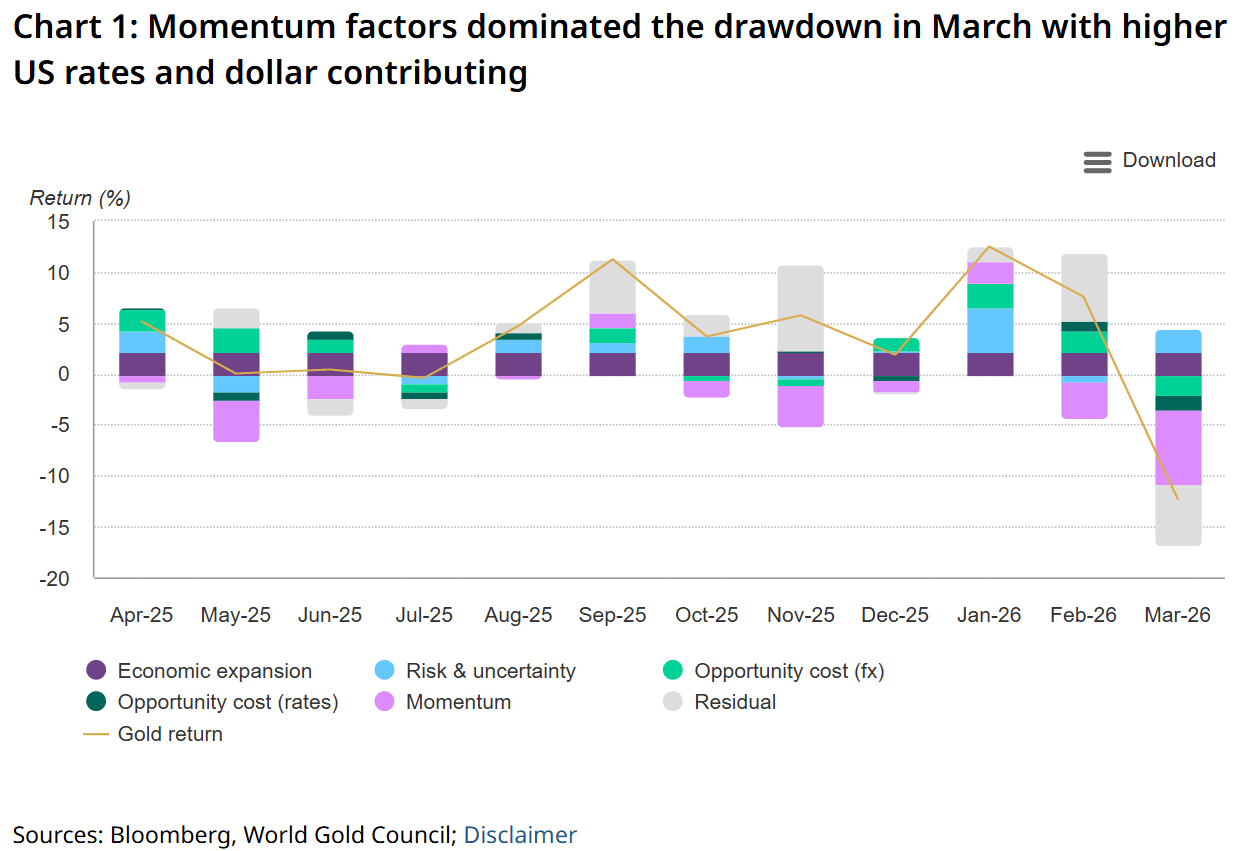
“Gold fell 12% in March to US$4,608/oz, its weakest month since June 2013,” they wrote. “Gold lost value in all major currencies, but remains up on the year. Our monthly attribution model GRAM captured the sentiment – but not the magnitude – of the move, attributing much of the drop to momentum factors: global gold ETF outflows, a COMEX net long unwind and a price trend reversal. Lesser contributions came from US dollar strength and yields.”
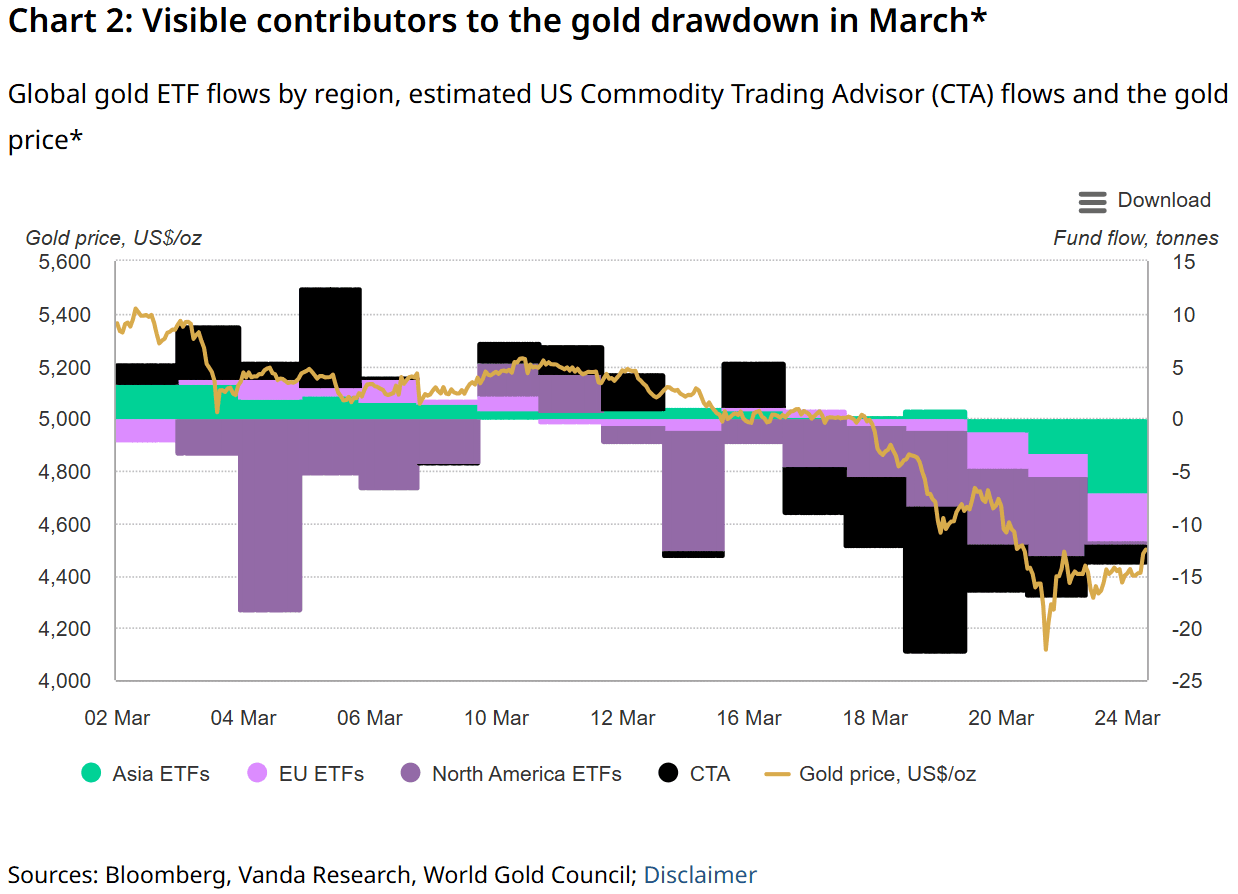
The analysts noted that while global gold ETFs saw $12 billion in outflows during the month – representing 84 tonnes of the precious metal – the liquidations were concentrated almost entirely in North America ($14 billion or -87t) and Europe ($0.1 billion or -7t. “Asia’s US$1.9bn (10t) inflows were a welcome positive, and highlight how dip-buying in Asia translated into much larger fund flow but lower equivalent tonnes.”
“COMEX managed money net long positions dropped US$2bn (19 tonnes) in March, but retain a solid long bias,” they added.
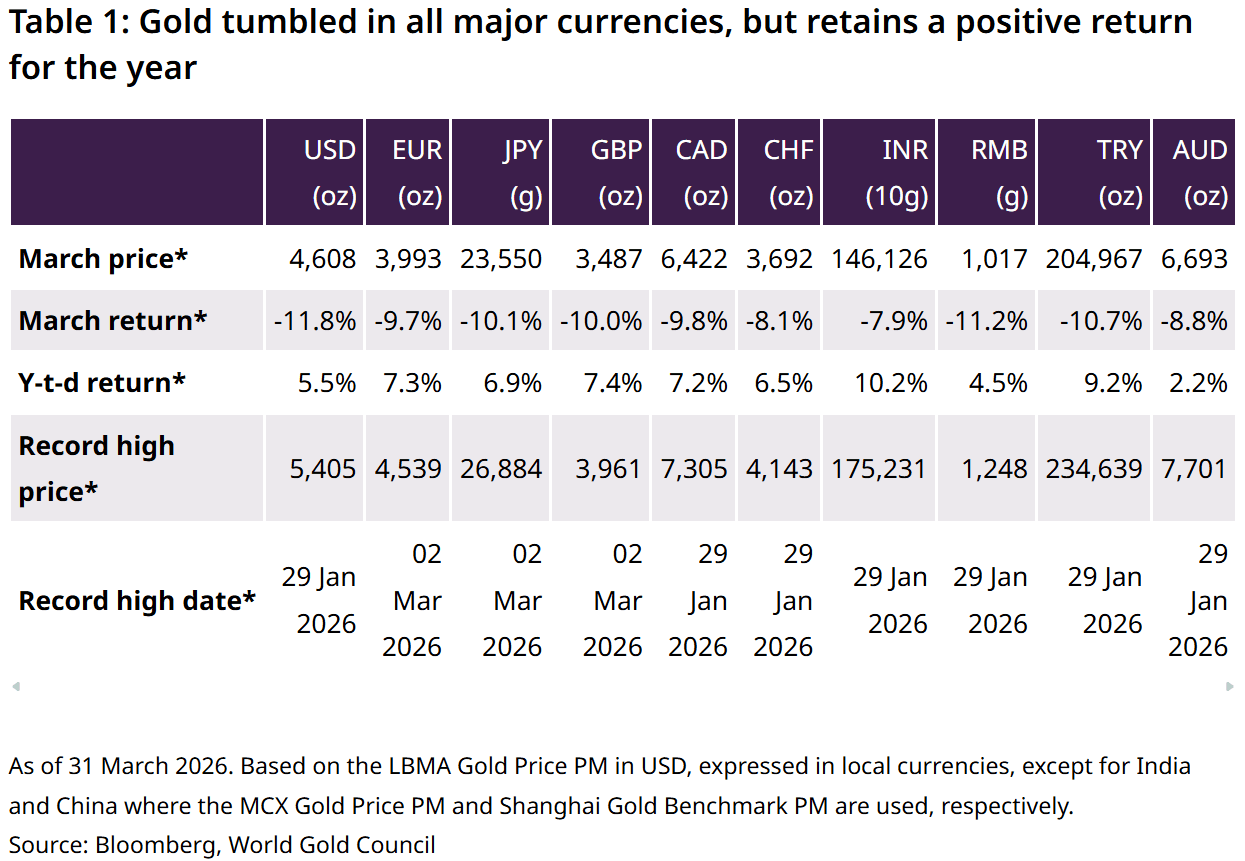
The WGG analysts’ postmortem suggested that “deleveraging and liquidity dynamics rather than shifting fundamentals led the March sell‑off, while disruptions to Middle East flows likely had little impact on global gold prices
“There are some green shoots to resuming gold’s positive trend, but short-term risks, including central bank mobilisation and further deleveraging, remain,” they added.
The World Gold Council said gold’s decline was a result of investors and traders selling what they could rather than what they wanted to be rid of.
“Gold’s sell‑off during the first three weeks of March was sharp, counter‑intuitive, but not unprecedented,” the analysts noted. “It occurred against a backdrop normally supportive for gold: elevated geopolitical tensions and renewed inflation concerns. The episode is a reminder that gold is not a contractual hedge. Prices rise only when incremental buyers exceed sellers. In March, deleveraging and liquidity needs tilted that balance in favour of sellers.”
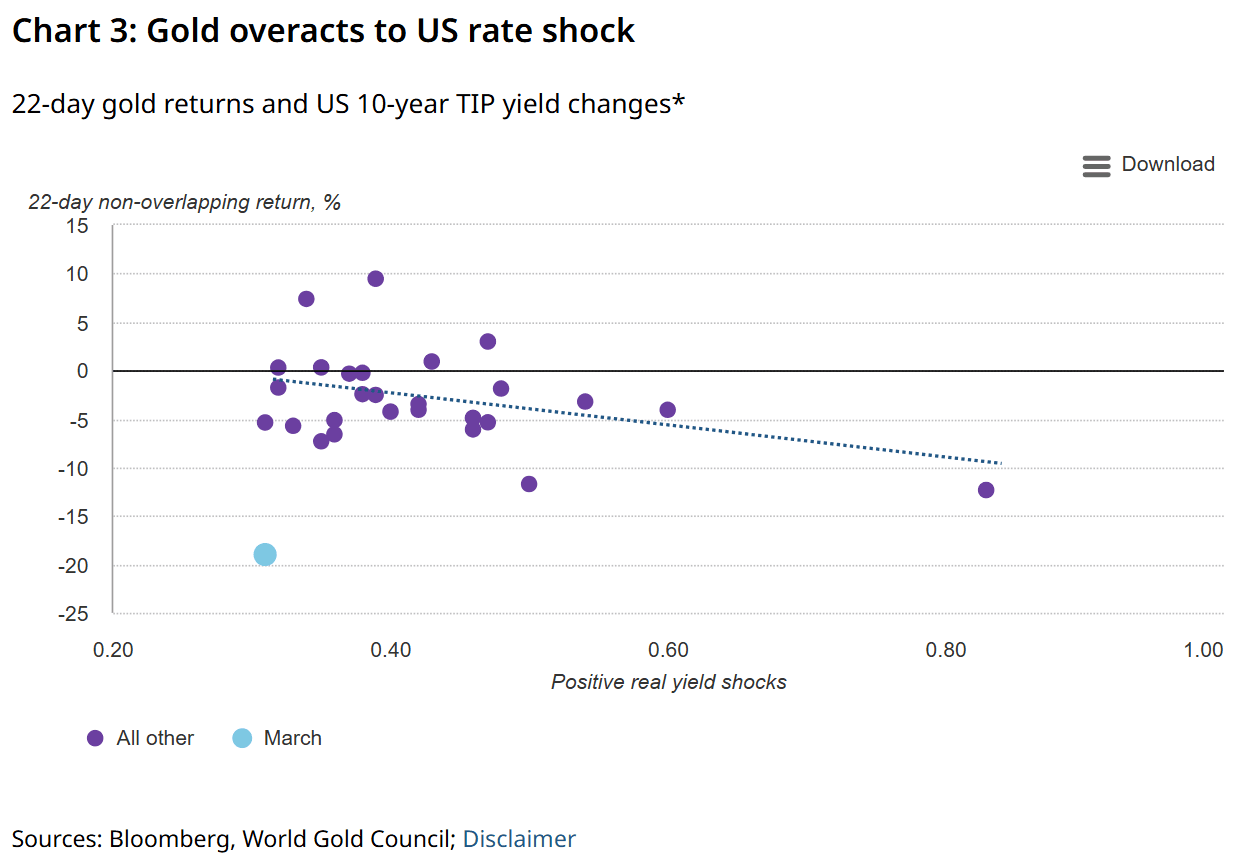
“Over the three weeks to 24 March, gold appeared to overreact to a conflict-led bounce in US real yields,” they noted. “The dollar also rose but it was modest.”
“Our weekly GRAM model reflected this dynamic with a 12% cumulative negative residual over the period,” the analysts said, adding that while real yields and the dollar definitely contributed to the gold selloff, other factors were also significant drivers.
First, the positioning of market players shifted. “A reported build up in retail exposure to gold risked a flush out,” they noted. “COMEX Non-Reportable positions, often associated with retail exposure, saw a cumulative 18t net drop during the first three weeks – in line with a 22t drop in Managed Money – reflecting more institutional money. A portion of gold ETF sales would also likely have been from retail hands. Global gold ETFs lost a net 80t between the beginning of March and the 24th, with the US accounting for the bulk of those.”
The second factor was CTA-driven selling, which the WGC believes likely amplified gold’s downside momentum.
“Estimated and anecdotally reported Commodity Trading Advisors (CTA) were very long heading into mid-March,” the analysts wrote. “They reportedly unwound positions sharply when gold broke through its 50/55-day moving average on 16 March for the first time in seven months.”
Broader cross-asset deleveraging likely spilled over into gold as well. “Elevated margin debt relative to market capitalisation probably contributed to widespread equity selling, with all but one sector in the S&P 500 (energy) posting declines,” they noted. “Against that backdrop, gold was not immune to liquidation pressure. Deleveraging by multi‑asset investors – including CTAs with exposure to equities, likely generated incremental selling in gold as positions were reduced to meet liquidity needs and reduce portfolio VaR.
The fourth factor contributing to the selling pressure was the dynamics in the bond market dynamics. “US bonds were sold on a near-term inflation shock with 2-year nominal yields and breakeven rate shooting higher,” the WGC said.
The fifth key factor was the real and speculative intervention of central banks in the gold market. “A decision by The Central Bank of the Republic of Türkiye (CBRT) to use approximately 50t of gold as collateral, predominantly via swaps, may have fuelled rumours of selling,” the analysts wrote. “There is precedence for such activity – during the 2023 earthquake and during COVID. As a major purchaser of gold since 2017 Turkey’s decision reiterates the basic rationale for why gold is indispensable as a reserve asset during market turbulence.”
“That this was liquidity driven and not a change in gold strategy is backed up by data at the US Fed suggesting increased outright selling of US Treasuries by central banks to buffer higher energy price risk was occurring in tandem,” they added.
And while the flow of goods to and from the Middle East was seriousl;y disrupted during this period, the WGC doesn’t believe this had any material impact on global gold prices.
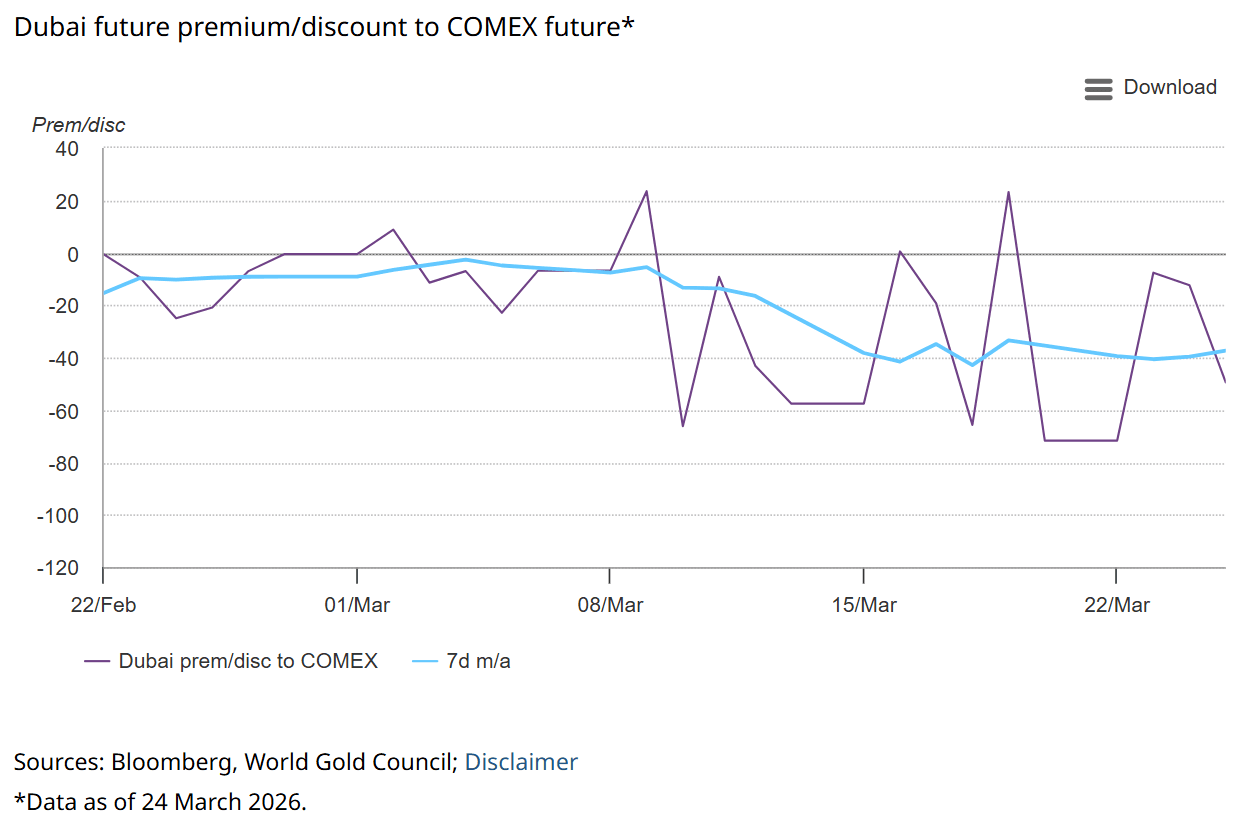
“Travel disruptions and lower tourist footfall weighed on demand for jewellery and small bars, particularly from foreign buyers,” they noted, while local prices “moved into a deeper discount to COMEX, though the adjustment was modest. Trading volumes in Dubai increased during the period, but at levels insufficient to influence international prices.”
The analysts said selling from high‑net‑worth investors was also not likely a factor in the March price decline. “They are anecdotally mobile and many hold gold outside the region, notably in Swiss vaults,” they said. “Any observed outflows seem more consistent with relocation than liquidation.”
The WGC also pushed back against another popular narrative – that Gulf nations were selling gold to raise cash or support local currencies. “While sovereign or quasi‑sovereign activity is one channel capable of influencing global prices, there is – for now – no evidence that oil exporters used gold for liquidity during the period,” they said.
“Overall, while regional disruptions may have affected local pricing and activity at the margin, they do not convincingly explain the scale or speed of the March sell‑off, which was driven primarily by financial market deleveraging.”
Looking ahead, the World Gold Council said it expects to see gold’s supportive fundamentals reassert themselves in the marketplace, but it also warned that risks remain.
The analysts pointed to early signs of stabilization in the gold market. “The dollar struggled to sustain gains and failed to push meaningfully beyond recent highs, reducing one source of near-term pressure,” they said. “Early April ETF flows into gold have been positive across regions.”
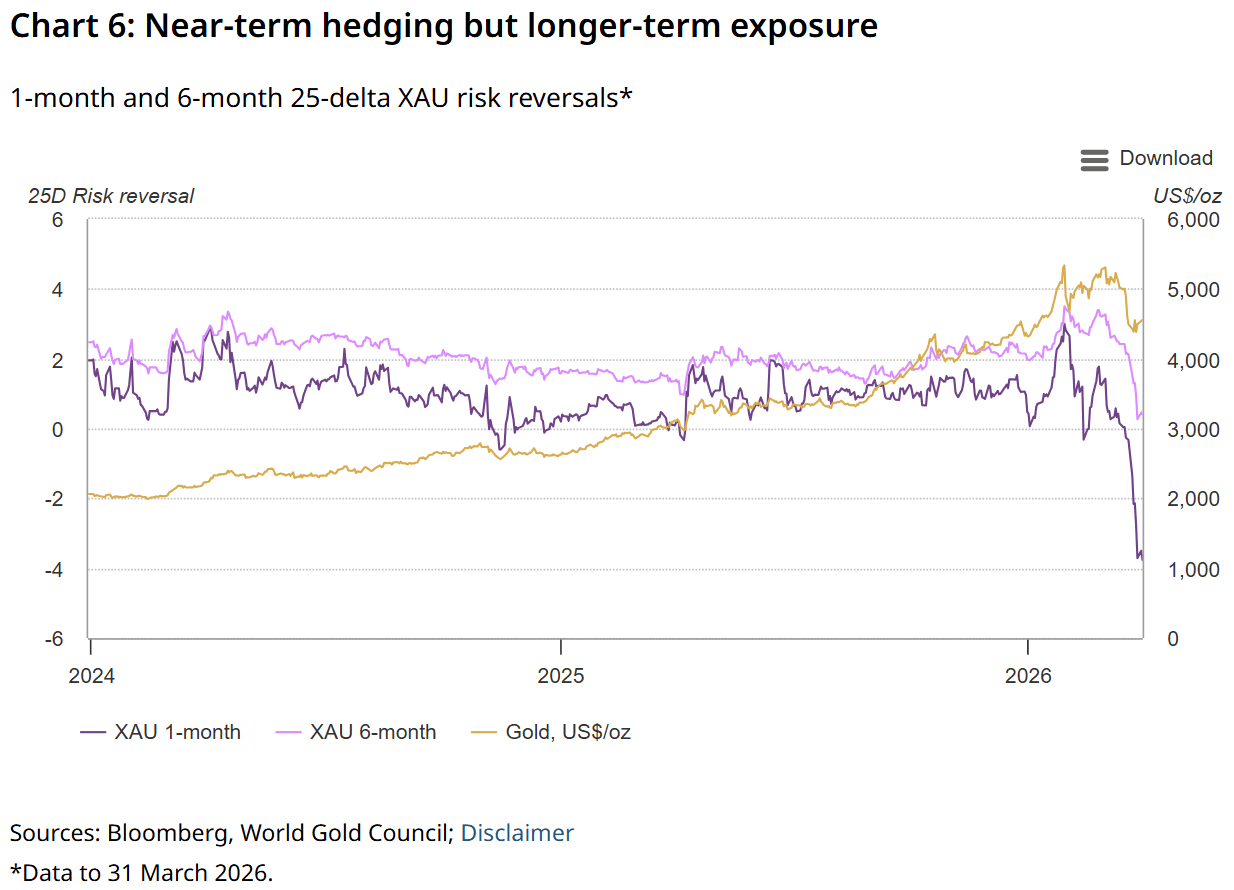
“Options markets point to elevated near‑term hedging demand, but a more constructive bias further out the curve, suggesting investors continue to view gold favourably over a medium‑term horizon,” they noted.
“Policy tightening is likely to be rhetorical (in the US) and expectations of hikes could get unwound quickly,” the analysts said. “Any energy-driven CPI impulse is likely to result in demand destruction, limiting pass-through to core inflation and reinforcing the case for an eventual dovish pivot.”
They also cited anecdotal reports of wealth management, retail and physical demand reemerging after gold prices successfully stabilized above key technical levels.
The WGC warned, however, that significant risks remain. “Should the conflict keep oil prices well in excess of US$100/bbl for an extended period – given that the somewhat muted response was reportedly due to buffers that no longer exist – this could risk further cross‑asset deleveraging, yield blow-outs, or gold mobilisation by the official sector,” they said. “As such, while fundamentals remain supportive, price action in the near term is likely to remain sensitive to conflict-driven liquidity needs rather than macro signals alone.”