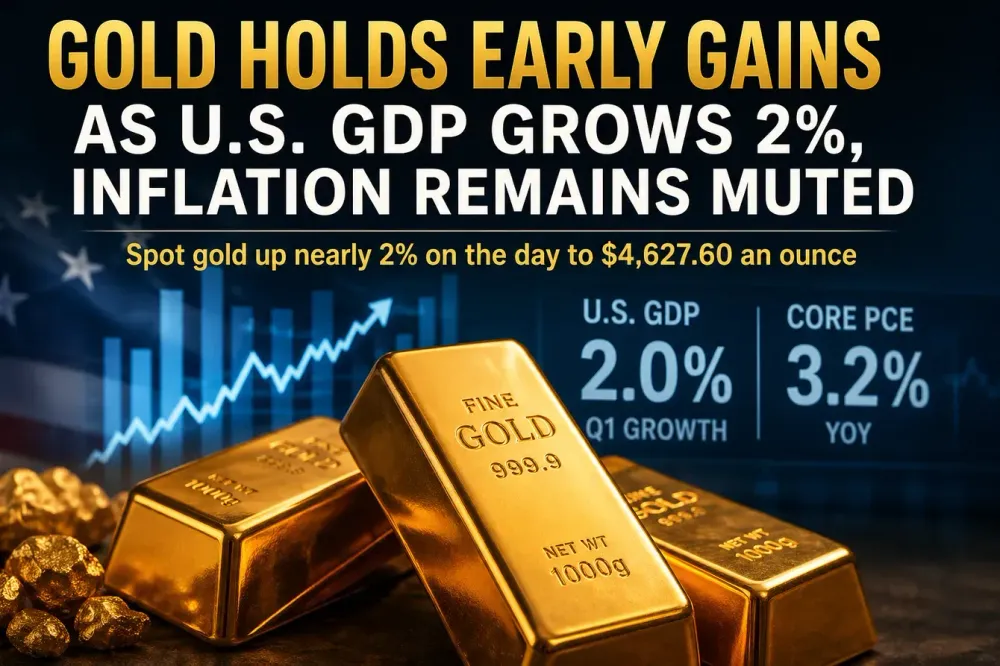
Gold prices holding gains but doesn't find any direction as U.S. Q1 GDP rises 2% and core inflation increase to 3.2%
The gold market is holding on to early morning gains but is not finding any major direction from the latest U.S. economic data, as economic growth continues to slow and core inflation remains muted.
In the first look at U.S. first-quarter data, the Gross Domestic Product (GDP), the U.S. Bureau of Economic Analysis (BEA) announced on Thursday that the economy expanded by 2% in the first three months of the new year, up from 0.5% growth reported in the fourth quarter.
Although the U.S. economy continues to expand, the pace of growth was slower than expected. According to consensus estimates, economists were calling for 2.2% growth in Q1.
“The contributors to the increase in real GDP in the first quarter were investment, exports, consumer spending, and government spending. Imports, which are a subtraction in the calculation of GDP, also increased,” the report said.
In a separate report, the BEA also said that inflation pressures, while elevated, are not exceeding expectations.
The Personal Consumption Expenditures (PCE) Index rose 0.7% last month, up from February’s increase of 0.4%.
Economists note that the global energy supply crisis caused by the war in Iran continues to drive headline prices higher. For the year, inflation rose 3.5%.
However, the report also noted that higher consumer prices have not become embedded in the broader economy. Core PCE, which strips out volatile food and energy prices, rose 0.3% last month, compared to February’s increase of 0.4%.
In the last 12 months, core inflation rose 3.2%.
While core inflation is not seeing an extreme acceleration, it still remains well above the Federal Reserve’s target of 2%, which some analysts have said creates a headwind for gold.
So far, the precious metal has not seen any major reaction to the relatively benign economic data. Spot gold last traded at $4,627.60 an ounce, up nearly 2% on the day.
Adam Button, Chief Market Strategist at Forexlive.com, pointed out that the rise in inflation adds important perspective to the Federal Reserve’s monetary policy decision made on Wednesday.
Although the Federal Reserve left interest rates unchanged following its monetary policy meeting, some committee members discussed shifting the central bank’s easing bias to a neutral stance because of rising inflation risks.
“With Core PCE now well above 3.0%, you can see why some FOMC policymakers wanted to drop the easing bias,” said Button.
Button added that inflation, combined with Q1 GDP, continues to highlight growing stagflation risks, saying the data is “stagflation-adjacent.”
Although consumer consumption continues to provide some support for the U.S. economy, the PCE report shows that consumers are spending above their means.
The report said personal income increased by 0.6%, following a 0.1% drop in February. Income increased more than expected, as economists looked for a 0.3% increase. Meanwhile, personal consumption increased 0.9%, compared to February’s increase of 0.5%. Consumption increased in line with economists' expectations.