
Wall Street and Main Street bulls reclaim half the market as traders look to potential Iran deal and April jobs report for direction

Gold prices ended the week lower after a volatile five-day stretch that saw early selling pressure followed by a late rebound, as markets weighed persistent inflation risks against safe-haven demand while the Middle East conflict and central bank announcements dominated the headlines.
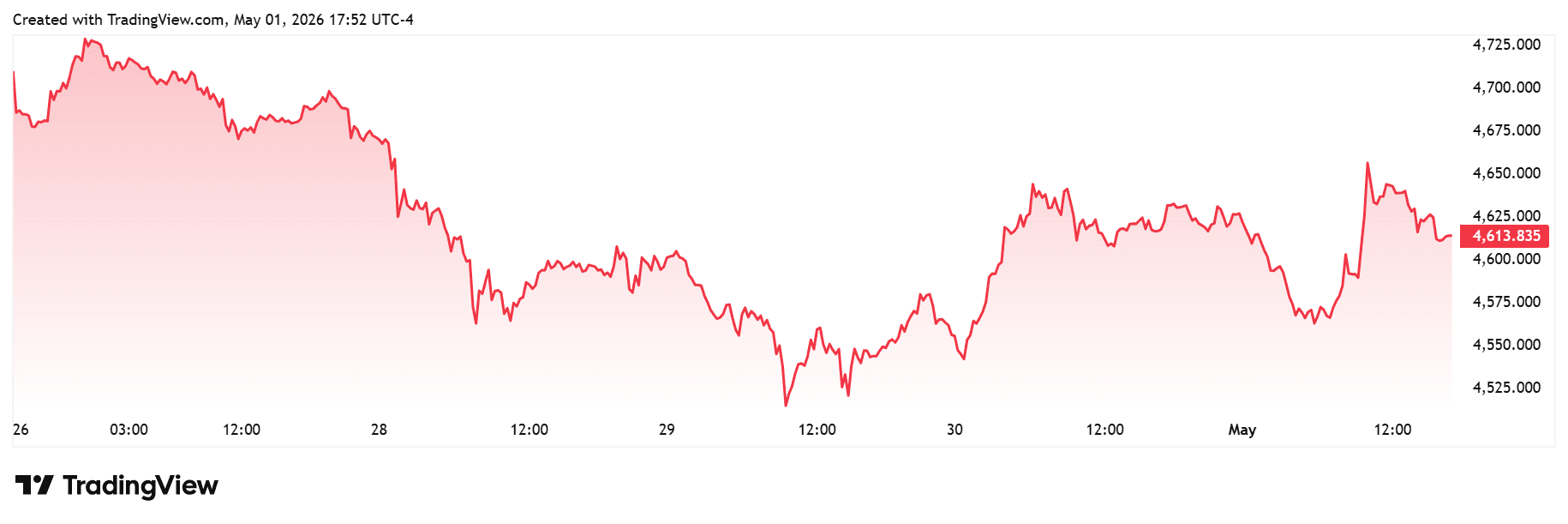
Spot gold kicked off the week trading at $4,685.50 per ounce, and after quickly spiking to set the weekly high near $4,730 per ounce, prices came under significant pressure on Monday and Tuesday, with gold falling to a low near $4,560 on Tuesday as rising oil prices and a stronger U.S. dollar pushed Treasury yields higher and reinforced expectations that interest rates will remain elevated for longer. The surge in crude intensified inflation concerns, which reduced the appeal of non-yielding bullion and triggered steady liquidation through midweek.
Gold hit the weekly low near $4,510 per ounce at the North American open on Wednesday morning, and after a bounce back up to $4,560, the selling resumed following the Federal Reserve’s latest policy signals in the afternoon, which highlighted divisions among policymakers and dampened expectations for near-term rate cuts. The hawkish tone added further support to the U.S. dollar, keeping gold pinned near weekly lows as investors reassessed the path of monetary policy.
Despite the early-week weakness, gold prices found support later in the week, with spot gold spiking near $4,650 early Thursday morning, and after one last slide down to test near-term support at $4,560 early Friday, the yellow metal saw a modest rebound through the rest of the day as markets digested the Fed decision and ongoing geopolitical uncertainty amid thin trading conditions.
But even with the late-week bounce, gold still posted another weekly decline, falling nearly 2% as worsening rate expectations and elevated energy prices continued to act as a headwind for the precious metal.
The latest Kitco News Weekly Gold Survey showed half of Wall Street and Main Street believing that gold could post renewed gains next week, with another third expecting further declines.
“Up,” said Rich Checkan, president and COO of Asset Strategies International. “I believe we are due for a little surge after this past week’s FOMC-induced sell-off. I expect moderate gains in gold and silver as tensions continue in the Middle East. I still do not see a sustained rally until the situation between the U.S./Israel, and Iran is resolved.”
James Stanley, senior market strategist at Forex.com, sees gold prices trending higher next week.
“April was a month of indecision and bulls have held on well, all factors considered, at least from what I’m watching,” Stanley said. “I still want to favor the broader bias until there’s more concrete evidence that something is shifting there.”
“Up,” said Darin Newsom, senior market analyst at Barchart.com. “I jumped the gun a bit last week, but continue to look for June contract to rally this coming week based on slightly more bullish momentum indicators.”
“Nothing has changed fundamentally, as central banks continue to load up on gold,” Newsom added.
Daniel Pavilonis, senior commodities broker at RJO Futures, told Kitco News he expects gold and silver prices to continue moving inversely to oil, and together with equities.
“Earnings were pretty good, and we seem to be in risk on-right now,” he said. “We did see that V-bottom on gold at the tail end of last month, and into this month we started to move higher, had another pullback, and now we're bouncing again.”
“I think this could be sustainable, even if crude oil just stays at this level, it just doesn't get too crazy or too volatile,” he said. “If it comes off pretty cleanly and trending to the downside, obviously that's better. I think you're still going to see buying in gold, still being a risk-on environment, but it's still very cautious right now.”
Pavilonis said he thinks markets are growing more comfortable with the status quo of the Iran conflict under the ceasefire, and they’re also growing more optimistic that a resolution could be on the horizon.
“Prices are elevated, but I think the market is coming to grips with the realization that we can be here [at these oil price levels],” he said. “The data is fine, it's not the end of the world. We've been here before, and it doesn't look like there's major escalation here. We're probably closer to the light at the end of the tunnel in terms of some type of an agreement, as opposed to the other direction, where we're more kinetic and we're blowing stuff up.
“I think the market is taking in that calm, but also being cautious, because this thing could obviously turn either way.”
Pavilonis said because gold doesn’t have the benefit of earnings and dividends to drive its own positive headlines, it’s been relegated to passenger status during the conflict – but gold’s 2025 drivers are still there in the background.
“That's really what it is,” he said. “What's the news? What's driving this thing? Where's open interest going? We'll see what the commitment of traders looks like. But I think if we get back towards $5,000, the overall theme has not changed: We're still heavily indebted, we're one of the many countries heavily indebted, and there's currency risks everywhere, interest rate risks everywhere, possibility of devaluing currency, because realistically, how else are you going to get out of this much debt?”
“I think the underlying [drivers] are still there,” he added. “It's just the sensationalism of ‘Hey, we need to get into this right now,’ is not there. You're starting to see high-level investors start to put some money into the market, and that's why you're seeing the market move higher and these pullbacks are getting bought up. But again, it's still cautious. I would imagine above $5,000 you start to see more and more money come into the market and push this thing higher.”
Pavilonis warned that this weekend could bring a surprise development in the Iran conflict, as other long weekends have.
“If there is going to be some kind of substantial move here, I think it's got to be now – because of the May Day holiday, this would be the time to do it,” he said. “Stocks are at all-time highs, oil's pretty low. If you're going to make a move on Iran this would be the ideal time to do it. I'm not saying that it's going to happen, but it would be interesting if it did happen. We're going into the weekend, and this is usually when things pan out.”
This week, 16 analysts participated in the Kitco News Gold Survey, with Wall Street sentiment turning more bullish amid Iran optimism and risk-on price action. Eight experts, or 50%, expected to see gold prices move higher during the week ahead, while five others, representing 31% of the total, predicted a price decline. The remaining three analysts expected consolidation during the week ahead.
Meanwhile, 79 votes were cast in Kitco’s online poll, with Main Street investors mirroring their professional counterparts. 36 retail traders, or 46%, looked for gold prices to rise next week, while another 24, or 30%, predicted the yellow metal would lose ground. The remaining 19 investors, representing 24% of the total, expected gold prices to trend sideways next week.
After a week where central banks dominated the economic news calendar, next week promises some of the most significant indicators, with April’s employment report the key data release.
Tuesday morning will see the release of the ISM Services PMI, with traders looking to see if the services sector is also losing steam after Friday’s downbeat manufacturing data. Markets will also be paying attention to JOLTS job openings and New Home Sales for February and March.
Then on Wednesday, traders will be watching the ADP Employment report for an indication of what nonfarm payrolls will show, followed by the Thursday morning release of weekly jobless claims.
The week’s data culminates with the Friday morning release of the employment report for April, followed by preliminary University of Michigan Consumer Sentiment for May.
“The yellow metal looks tarnished,” said Marc Chandler, managing director at Bannockburn Global Forex. “The bounce off mid-week low (~$4510) stalled near $4647. It looks poised to test $4495, which is about the halfway point of the advance from the March 23 low (~$4099).”
“The momentum indicators are falling, and the five-day moving average is below the 20-day moving average," he added. "A break of the $4495 area could signal another leg down to $4400."
Adam Button, head of currency strategy at Forexlive.com, was unpacking the implications of this week’s central bank announcements.
“If you take a step back to two months ago, every central bank is more hawkish than it was,” Button noted. “If you go globally, we probably priced in 50 basis points [to rate expectations] no matter where you are: You take every single global central bank and add 50 basis points – maybe not emerging markets, but every developed global central bank – you can add 50 basis points to wherever you were on February 28th.”
Button said this represents either rate hikes, or in the case of the Fed, reduced expectations of easing. “The Fed, you lost fifty,” he said. “Japan, you probably gained fifty. Canada you're priced in for a hike now.”
“The Bank of Canada is revealing, because they said, ‘Here's our forecast, and it's priced with Brent [crude oil] at $90,’” he said. “Yesterday we were at a $128. So throw out the forecast.”
“But you sympathize with them, because Monday we could be back at $95,” he continued. “I guess what you're trying to suss out is, what will they do if oil goes to $150? How likely are they to ‘look through’ that? And then even if, say, the war ends now and you have this kind of slow drift to $80, maybe $75 at year-end, how likely are they to look through that? You get the sense that they're not; the ECB's not that likely to look through it, the Bank of England is concerned, the Bank of Canada will probably hike too. The Fed's the one that matters, and you just don't have a good read right now.”
“It's difficult to look through tariffs and inflation, tariffs and oil,” he said. “You can't have two one-offs.”
Button said the new Fed chair will inherit a very tight situation, and it will be very difficult for Warsh to justify cutting rates, no matter how much he wants to please Trump.
“You're creating huge government stimulus with the ‘Big, Beautiful Bill,’” he said. “You’re creating tariffs, which are inflationary. Now you're creating a war that's inflationary, and you're layering it on this AI capex spend, just a crazy inflationary power spend. If [Trump’s] plan is to improvise, to stack the Fed and get rates low, it's not going to fix inflation. If you have an improviser in the White House, it's so bullish for gold, because you don't know what's going to break. Maybe it's not inflation, maybe it's that this war keeps going on. Maybe, you have a breakdown in the transatlantic partnership. Maybe you have domestic instability. When you don't have a strategy, you have instability, and you have a mess. And eventually, you have a mess you can't clean up.”
Turning to the Middle East, Button said he remains hopeful that the Iran war is nearing its end.
“I'm an embarrassing optimist on this war ending,” Button said, “But it did come out today that Iran delivered a new proposal yesterday. Oil tanks yesterday for no reason, and then we find out the proposal came in yesterday, and nobody knew about it? Give me a break. But nobody wants war. Wrap this thing up.”
“The war ends, gold goes to $5,000 in a few weeks, and beyond,” he said. “The war continues, emerging markets have to sell gold to pay current accounts, and for oil imports. So it's pretty binary.”
“I'm 51% confident gold will be higher next week.”
Alex Kuptsikevich, senior market analyst at FxPro, expects gold prices to fall further next week.
“At the end of the week, gold is down around 3%, having fallen by more than 4.3% at its low, but found strong support around the $4,540 level,” he wrote. “Gold is thus continuing the downward trend that began in the second half of April after testing the 50-day moving average.”
“The fundamental drivers remain the reassessment of monetary policy prospects towards a tighter stance, which boosts the appeal of government bonds,” Kuptsikevich said. “It is also interesting to note that gold is struggling to capitalise on the US dollar’s weakening momentum, which has had a significant cumulative effect over the month: from its highs on the last day of March, the dollar index has lost 2.5%, whilst gold has lost over 4%, and from its peak in mid-April to the lows of the past week – around 8%. Usually, these instruments move in opposite directions, and the current dynamics look like a warning sign for the precious metal’s medium-term prospects. We see this as a continuation of significant profit-taking following years of growth and are prepared for lower levels in the foreseeable future.”
Kuptsikevich pointed to the area around $4,400 per ounce as an important checkpoint for gold on the way down, as this is where the price consolidated at the end of March.
“The price may well reach this level next week,” he warned. “A decisive move down from these levels would make a downward trend the central scenario within a broad sideways range, with turning points at the local highs of January, March and April. Movement within this range could become the trend for the next few years, with the final point being a touch of the 200-week moving average (currently near $2,700, but trending upwards).”
Analysts at CPM Group issued a sell recommendation on Thursday afternoon, with an Initial Target Price of $4,500 between May 1 and May 15, and a Stop Loss at $4,715.
“CPM has been projecting prices would remain volatile in a sideways to upward fashion throughout April,” they wrote. “The range we used for the second half of the month was $4,400 - $4,950. Gold prices, in fact, have traded in a volatile sideways range over April.”
The analysts said that while prices may remain in that range, there is a clear downward bias emerging. “Investors have pulled back from buying in some sectors, not just for gold or precious metals, but across commodities,” they said. “Long-term political and economic concerns have increased, but shorter-term expectations have grown less anxiety-ridden.”
“In this environment, CPM is issuing a Gold Sell Trade Recommendation for the ultra-short term,” they wrote. “We are using closer in targets and stop loss levels, since we would not be surprised to see markets continue to trade sideways in a volatile fashion on an ultra-short term basis. That said, the bias does seem to point to spikes lower in the near term. A break to the target here of $4,500 might lead to profit taking.”
“Larger declines are possible over the next four months or so,” they warned, “but for now, prices may remain range-bound.”
Michael Moor, founder of Moor Analytics, expects to see higher gold prices next week, but warned that prices could retrace if they break below key near-term support levels.
“Higher, unless we take out lower timeframe formations mentioned below,” he wrote. “In a Higher time frame, I cautioned on 8/16/18, the break above $1,183.0 warned of renewed strength. We have seen $4,443.1. This is ON HOLD. We held exhaustion at 56192 with a 56268 high and rolled over $1,526.8. This is ON HOLD. On a medium timeframe basis: The trade below 52554 (+15 tics per/hour) projects this down $220 minimum, $740 (+) maximum—we attained $1,155.4. The trade back below 52036 (+13 per/hour) has brought in $1,103.6 of pressure. The trade back below 51606 (+13 per/hour) has brought in $1,060.6 of pressure. The trade below 48530 (+4 tics per/hour) has brought in $753.0 of pressure. These are ON HOLD. We held exhaustion at 40956 with a 41000 low and have rallied $817.7. The trade above 41814 has brought in $736.3 of strength. The trade above 43642 has brought in $553.5 of strength. The trade above 47119 (-12 tics per/hour) projects this upward $155 min, $540 (+) max—we attained $205.8 so far. These are OFF HOLD.”
“On a lower timeframe basis: We held exhaustion with a 49177 high and rolled over $395.5 into a bearish correction/trend and took out the minimum target of 46538. The break below 48185 projected this down $45 min, $185 (+) max—we attained $296.3. The trade below 47923 projected this down $75 minimum, $205 (+) maximum—we attained $270.1. The trade below 47069 brought in $184.7 of the pressure warned about. These are ON HOLD. We held exhaustion at 45231-100 with a 45222 low and have rallied $150.8. The trade above the 46010 (-12 tics per/hour) line has brought in $72.0 of strength. The break above 46291 (-10 per/hour) has brought in $43.9 of strength; but if we fail back below decently, look for decent pressure. A 'decent' penetration is $22.9 currently.”
At the time of writing, spot gold last traded at $4,613.83 per ounce for a loss of 1.77% on the week and 0.18% on the day.