Rio Tinto sponsors fund to manage impacts from decades-closed Panguna mine
Global diversified miner Rio Tinto, ASX-listed Bougainville Copper and governing authority Autonomous Bougainville Government (ABG) have reached an agreement with community leaders in Bougainville, Papua New Guinea, to establish a response fund for impacts having been identified by the Panguna Mine Legacy Impact Assessment (PMLIA).
Rio Tinto has committed $250-million to the fund.
The parties confirm that detailed remedy priorities and the scope of the efforts will be developed in consultation with communities, with resulting activities to be aligned with the United Nations Guiding Principles on Business and Human Rights.
"The fund represents a significant commitment to addressing impacts identified in the PMLIA. It will support practical responses in the river and delta areas, as well as social programs for communities across all impacted areas identified in the PMLIA, including the mine, port and town areas where mine redevelopment activities are underway," Rio Tinto states.
The PMLIA was initiated in response to a complaint by local communities, represented by the Human Rights Law Centre, about ongoing environmental and human rights impacts linked to the former Panguna mine.
The fund will support practical, sustainable, and coordinated responses across multiple stakeholders. The structure, governance and delivery arrangements of the fund will be developed in consultation with communities, the ABG, Bougainville Copper and Rio Tinto.
The fund's announcement follows extensive work by the PMLIA Oversight Committee, which brings together representatives from the Government of Papua New Guinea, the ABG, landowner and community representatives, BCL, Rio Tinto and the Human Rights Law Centre. The oversight committee has played an important role in overseeing the assessment of legacy impacts and subsequent investigations.
"This announcement builds on years of significant work by local community leaders to support the process and projects already underway in Central Bougainville to address high-risk impacts identified through the PMLIA.
"These projects include addressing ageing infrastructure that poses imminent and severe risks to nearby communities, removal of hazardous materials from the Loloho Port area, construction of bridges and measures to reduce flood risks, as well as geotechnical monitoring for local communities. A multi-year water and sanitation project to address acute needs in the former mine corridor is also underway," Rio Tinto states.
The fund and activities associated with it remain separate from future mine and port redevelopment decisions, which sit with the ABG and the people of Bougainville.
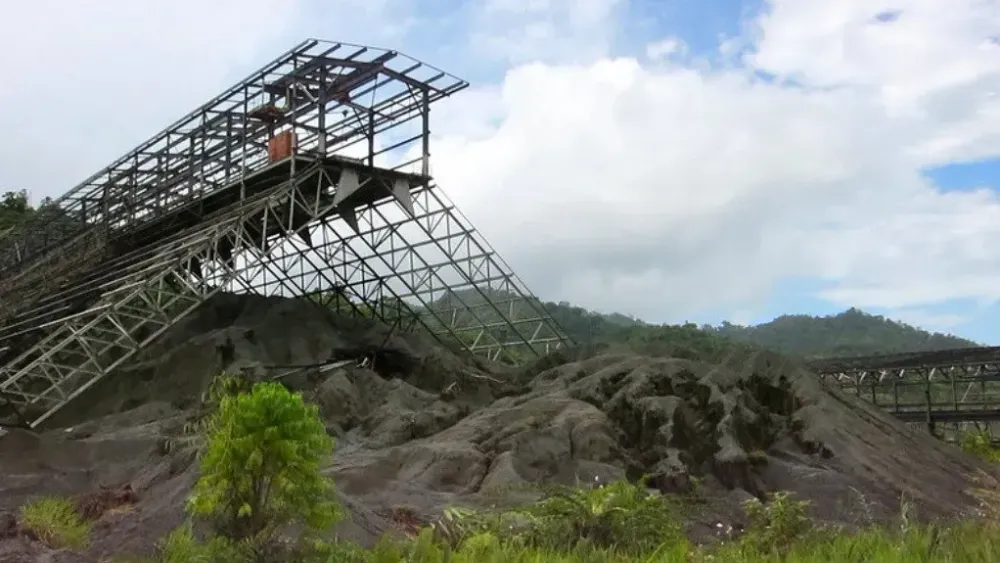
Panguna mine is a massive open-pit copper, gold, and silver mine located in the central mountains of the Autonomous Region of Bougainville, Papua New Guinea. Bougainville Copper - a subsidiary of Rio Tinto - started operating the mine in 1972, with the mine having grown to become one of the world's largest copper and gold producers.
The Panguna mine stopped operations on May 15, 1989, when local landowners and militia members sabotaged the facility amid growing anger over severe environmental damage and an unfair distribution of profits.