SAGA Metals Reports Best Drill Results To-Date at Radar Ti-V-Fe Project in Labrador
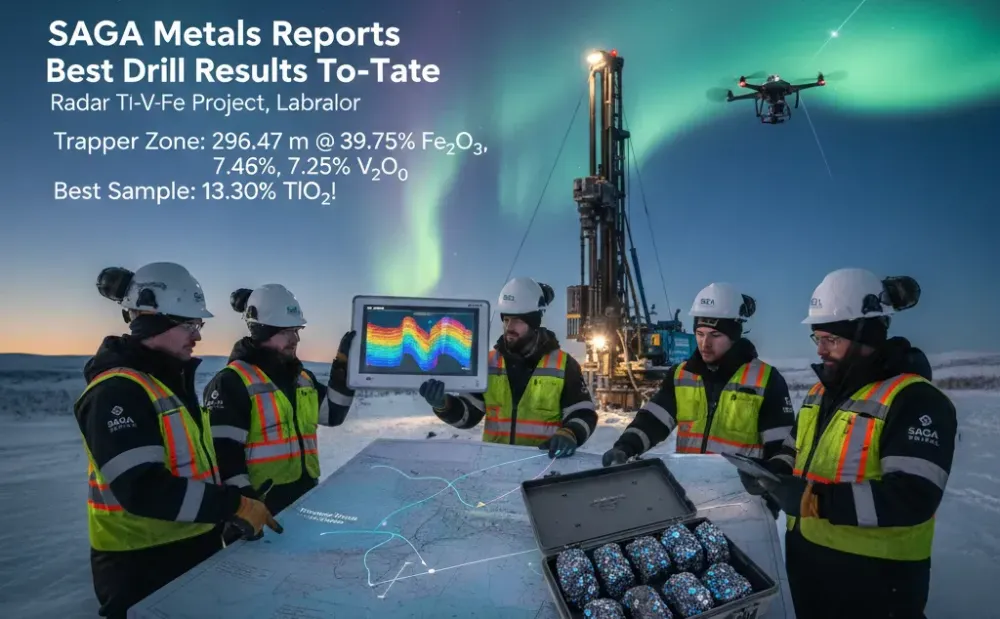
SAGA Metals Corp. (TSX-V: SAGA) (OTCQB: SAGMF) (FSE: 20H), a North American exploration company focused on critical mineral discovery, is pleased to announce the assay results for the first two of eight drill holes from the Company’s Phase 1 Mineral Resource Estimate drill program over the Trapper Zone at the Radar Ti-V-Fe Project, located near the port of Cartwright in Labrador, Canada.
Assay Highlights
Analytical results have been obtained for the first two diamond drill holes of the 2025 Phase of the Trapper Zone MRE drill program with full hole assays including:
Hole R-0008 (drilled from surface): 269.36 m @ 36.21% Fe₂O₃, 6.57% TiO₂, 0.244% V₂O₅
Hole R-0009 (drilled from surface): 296.47 m @ 39.75% Fe₂O₃, 7.46% TiO₂, 0.25% V₂O₅
193 out of 418 samples grading over 7% TiO2 with 97 out of 418 grading over 10% TiO2 (Majority are 2-meter sample length)
241 out of 418 samples grading over 0.2% V2O5 with 128 out of 418 grading over 0.3% V2O5 (Majority are 2-meter sample length)
Core sample 1800528 is the highest TiO2 to date with a 2 m assay of 13.30% TiO2.
Numerous exceptional intercepts including 87.20 m @ 50.67% Fe2O3 + 10.15% TiO2 + 0.339% V2O5. (See composites Table 1 below)
Overall significant increase of best full hole metrics of Fe2O3 (124% increase), TiO2 (105.90% increase) & V2O5 (36.90% increase) from Trapper North assays vs Hawkeye.
Significant increase in overall oxide concentration from Trapper Vs Hawkeye.
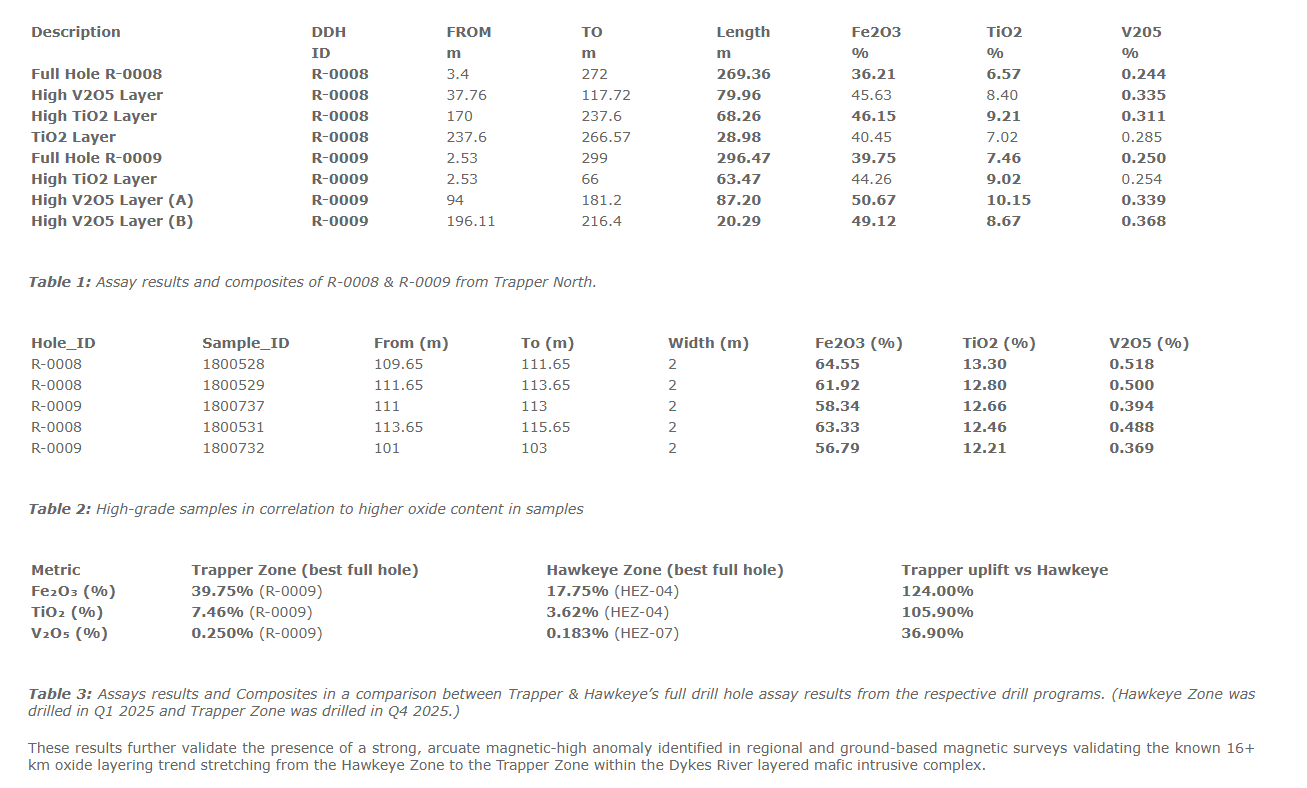
These results further validate the presence of a strong, arcuate magnetic-high anomaly identified in regional and ground-based magnetic surveys validating the known 16+ km oxide layering trend stretching from the Hawkeye Zone to the Trapper Zone within the Dykes River layered mafic intrusive complex.
Trapper Zone vs Hawkeye Zone Best Full Hole Drill Assay Comparison to-date:
Fe₂O₃: Trapper’s best hole (39.75% Fe₂O₃) is 124.0% higher than Hawkeye’s best (17.75% Fe₂O₃), establishing a clear iron-grade step-change.
TiO₂: Trapper sets a new titanium benchmark — 7.46% TiO₂, 105.9% higher than Hawkeye’s best (3.62% TiO₂).
V₂O₅: Trapper’s best vanadium result (0.250% V₂O₅) is 36.9% higher than Hawkeye’s best (0.183% V₂O₅).
Majority of Trapper’s assays are 2 m samples versus Hawkeye’s at 0.5 m.
The assay results from drill holes R-0008 and R-0009 not only validate the Trapper Zone and in-field hypothesis, but they also uphold VTM-Ilmenite ratios seen at the Hawkeye Zone. This suggests that the TiO2 values are related to overall oxide concentrations and not a change in mineralogy and that the results are vastly superior to what was considered a very successful maiden drill program at Hawkeye in Q1 2025.
The Trapper Zone has upheld the conclusion that the total percentage of observed oxide correlates directly to Fe2O3, TiO2 & V2O5 grades as seen in Figure 1 below.
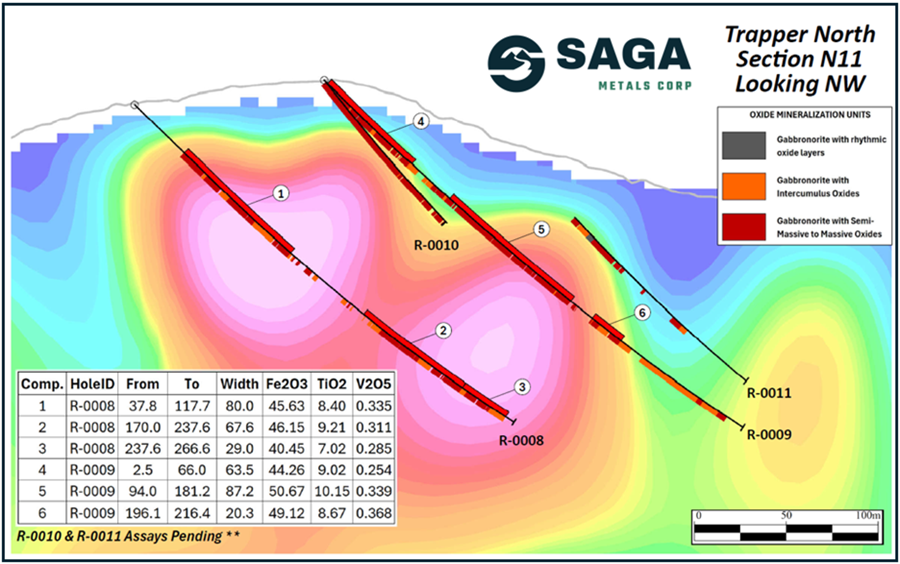
Figure 1: Cross-Section N-11 showing R-0008, -0009, -0010 and -0011 with the 3D Magnetic Inversion of the 2025 Trapper Zone ground magnetic survey. Composite grades within R-0008 and -0009 are highlighted and numbered 1 through 6. R-0010 and -0011 assays are pending.
Drill Hole R-0008 and R-0009 Summary
Phase 1 of drilling in Trapper North targeted a strong magnetic anomaly delineated in the 2025 ground geophysical survey. The anomaly traces the shape of an apparent fold structure. Drilling fences are oriented to cross the fold structure at right angles, with drilling directions of mostly N038°E. These two drill holes totaled 571 m and obtain the following observations:
R-0008 (Azimuth 38°, Dip -45°, EOH 272 m), was collared in the SW limb of a large fold closure in gabbronorite in Trapper North. Over half the length of the hole passed through intervals of semi-massive to massive oxide mineralization, with a cumulative total of 156 m out of 272 m of core length.
R-0009 (Azimuth 38°, Dip -45°, EOH 299 m), tested the remainder of the Trapper North fold structure. The drill hole was collared to intercept the NE limb of the fold and to complete the cross-section started with R-0008. Over half the length of the hole intersected semi-massive to massive oxide layering, with a cumulative total of 165 m out of 299 m of core length.
Next Steps
The Company expects to receive the next set of assays results mid-January, with the final batch due shortly after. Saga’s geological team will complete interpretations with the goal of releasing the results in a timely manner.
Crews are also expected to start mobilizing by mid-January as the Company plans to initiate its 2026 phase of the MRE drill program at the Radar Project’s Trapper Zone.
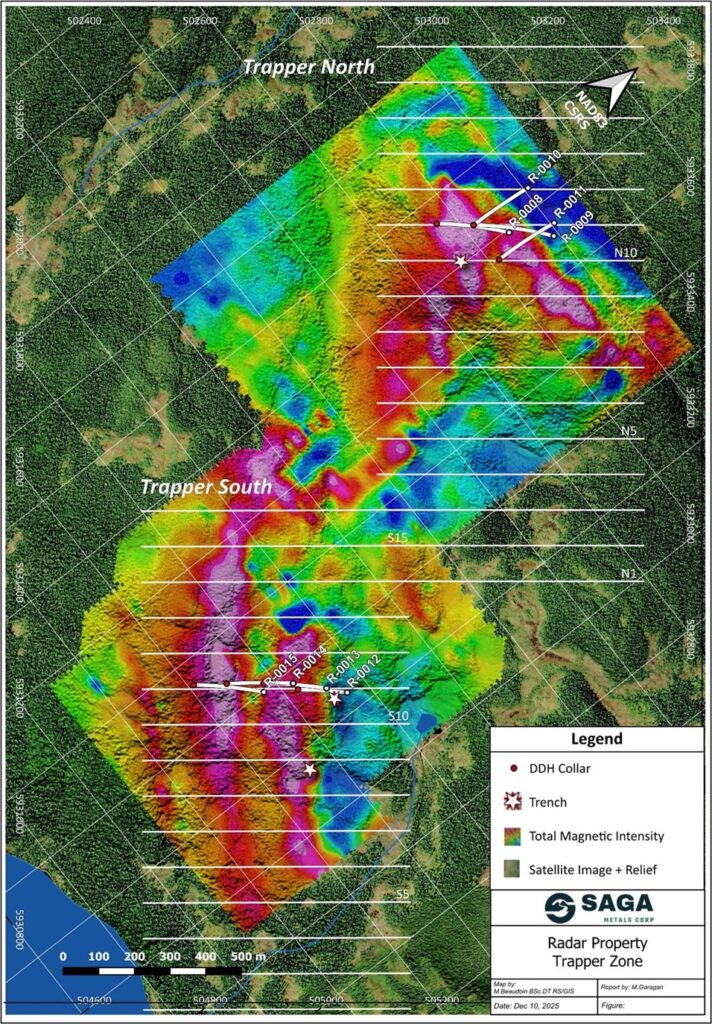
Figure 2: Location of the Fall 2025 phase of drilling at Trapper Zone, showing the TMI of the 2025 Trapper Zone ground magnetic survey as well as the grid for the MRE drill program to be completed in 2026.
About Radar Property
The Radar Property spans 24,175 hectares and hosts the entire Dykes River intrusive complex (~160 km²), a unique position among Western explorers. Geological mapping, geophysics, and trenching have already confirmed oxide layering across more than 20 km of strike length, with mineralization open for expansion.
Vanadiferous titanomagnetite mineralization at Radar is comparable to global Fe–Ti–V systems such as Panzhihua (China), Bushveld (South Africa), and Tellnes (Norway), positioning the Project as a potential strategic future supplier of titanium, vanadium, and iron to North American markets.
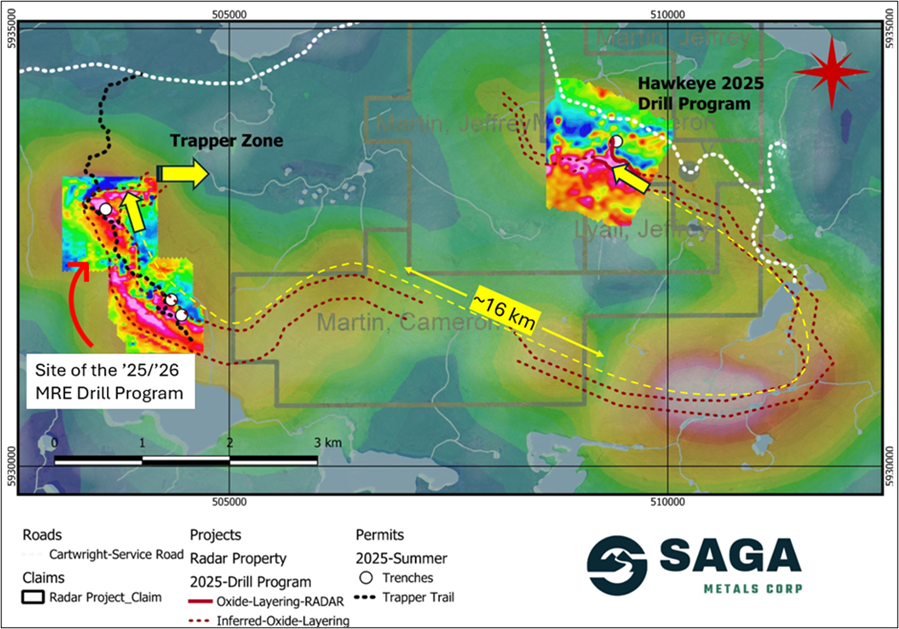
Figure 3: Radar Project’s prospective oxide layering zone validated over ~16 km strike length through Fall 2025 drilling, as shown on a compilation of historical airborne geophysics as well as ground-based geophysics in the Hawkeye and Trapper zones completed by SAGA in the 2024/2025 field programs. SAGA has demonstrated the reliability of the regional airborne magnetic surveys after ground-truthing and drilling in the 2024 and 2025 field programs.
Qualified Person
Paul J. McGuigan, P. Geo., is an Independent Qualified Person as defined under National Instrument 43-101 and has reviewed and approved the technical information disclosed in this news release.
Technical Information
Samples were cut by Company personnel at SAGA’s core facility in Cartwright, Labrador. Diamond drill core was sawed and then sampled in maximum 2 m intervals. Drill hole core diameter utilized was NQ.
Core samples have been prepared and analyzed at IGS laboratory facility in Montreal, Quebec. Blanks, duplicates, and certified reference standards are inserted into the sample stream to monitor laboratory performance. Crush rejects and pulps are kept and stored in a secured storage facility for future assay verification. The Company utilizes a rigorous, industry-standard QA/QC program.
About SAGA Metals Corp.
SAGA Metals Corp. is a North American mining company focused on the exploration and discovery of a diversified suite of critical minerals that support the North American transition to supply security. The Radar Ti-V-Fe Project comprises 24,175 hectares and entirely encloses the Dykes River intrusive complex, mapped at 160 km² on the surface near Cartwright, Labrador. Exploration to date, including a total of 4,250 m of drilling, has confirmed a large and mineralized layered mafic intrusion hosting vanadiferous titanomagnetite (VTM) and ilmenite mineralization with strong grades of titanium and vanadium.
The Double Mer Uranium Project, also in Labrador, covers 25,600 hectares and features uranium radiometrics that highlight an 18km east-west trend, with a confirmed 14km section producing samples as high as 0.428% U3O8. Uranium uranophane was identified in several areas of highest radiometric response (2024 Double Mer Technical Report).
Additionally, SAGA owns the Legacy Lithium Property in Quebec’s Eeyou Istchee James Bay region. This project, developed in partnership with Rio Tinto, has been expanded through the acquisition of the Amirault Lithium Project. Together, these properties cover 65,849 hectares and share significant geological continuity with other major players in the area, including Rio Tinto, Winsome Resources, Azimut Exploration, and Loyal Metals.
With a portfolio spanning key commodities critical to the clean energy future, SAGA is strategically positioned to play an essential role in critical mineral security.