
Seabridge clears KSM hurdle as Tudor abandons tunnel appeal
Gold developer Seabridge Gold has removed a potential hurdle to the development of its KSM project in British Columbia, with Tudor Gold abandoning its legal challenge relating to the Mitchell Treaty Tunnels (MTT).
Tudor filed a notice of abandonment with the Supreme Court of British Columbia, ending its appeal of a 2025 decision by the Chief Gold Commissioner (CGC), who had declined jurisdiction over an application challenging the applicability of a conditional mineral reserve (CMR) linked to the tunnels.
The move effectively upholds the CGC’s earlier ruling, removing a layer of legal uncertainty surrounding a key piece of infrastructure at the KSM project.
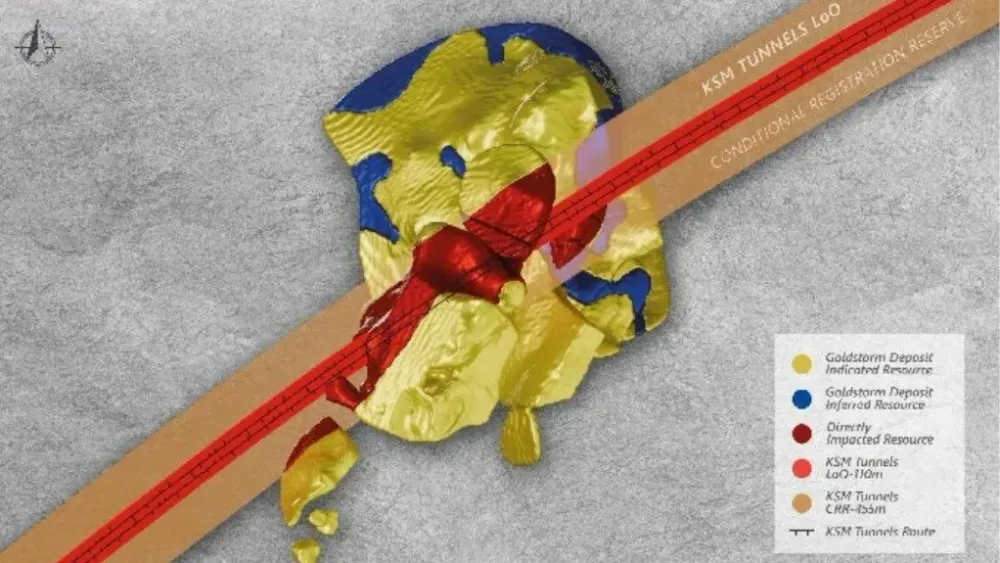
The dispute centred on whether the CMR governing the MTT – a critical component linking the east and west sides of the project – should apply to mineral claims held by Tudor. About 12.5 km of the twin tunnels are expected to pass through claims owned by Tudor.
Under the CMR, claimholders are required not to obstruct, endanger or interfere with the construction, operation or maintenance of the tunnels.
Seabridge chairperson and CEO Rudi Fronk said the withdrawal confirmed the company’s position.
“We applaud Tudor's decision to abandon its appeal, which lacked any merit from the outset. This action reinforces our position that the authorisations issued in favour of the MTT do not give Seabridge any interest in Tudor's mineral rights.”
Seabridge noted that the legal effect of the CMR has been consistently supported by the British Columbia Ministry of Mines for more than a decade.
Tudor previously proposed to shift 1 km northward the alignment of the 22-km tunnels that are intended to connect east and west sides of the KSM project. Tudor argued that about 12 km of the current tunnels would traverse its Treaty Creek claims, cutting through the Goldstorm deposit and piercing the under-explored Perfectstorm zone.
Tudor warned the tunnels plus an expected buffer zone would sterilise material ounces and constrain mine design and access, and it framed the modest increase in tunnelling – about 2.5 km, or roughly a 3.1% rise in KSM’s pre-production excavations – as a small price to preserve the development optionality of a second major project in the region.