
Warsh shakes the gold market
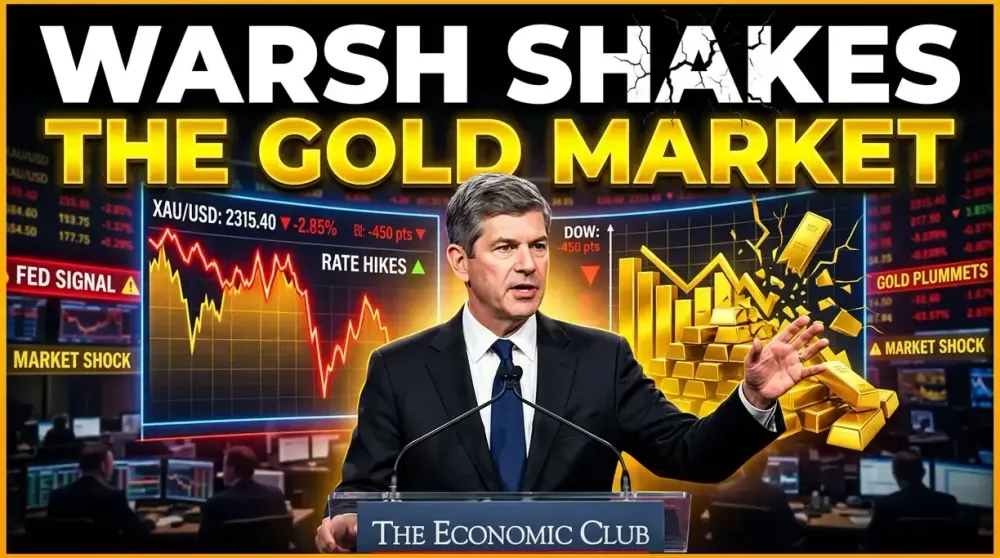
Gold futures entered Wednesday's Federal Open Market Committee session on firm footing, trading higher by just over $50 on the day ahead of the 2:00 PM ET announcement. Traders were positioned for the expected: a rate hold. What they were not positioned for was Kevin Warsh.
A New Fed Chairman's Debut Sends Bullion Tumbling — and Raises Questions About What Comes Next
Between the rate decision and the close of Warsh's press conference, gold shed $146 — a move of 3.31% — in a two-hour window that left the market recalibrating the entire landscape for monetary policy. The selling continued into Thursday, with gold futures closing down another $48.40, or 1.13%, at $4,227.90. With markets dark Friday in observance of Juneteenth, the next full trading session will not arrive until Monday.
The FOMC's decision to hold the federal funds rate steady at 3.50%–3.75% was unanimous — a 12-0 vote — and surprised no one. The shock came from what surrounded it. The Summary of Economic Projections shifted meaningfully in a hawkish direction, with the median year-end rate forecast rising to 3.8%, up from 3.4% in March, and nine of eighteen officials now penciling in at least one rate hike before year-end. Seventeen of eighteen judged inflation risks to be tilted to the upside.
But it was Warsh's conduct at the podium that drew the sharpest reaction. Most notably, he revealed that he abstained from submitting his own rate projections to the dot plot — the Fed's established forward guidance mechanism — while encouraging his colleagues to continue doing so. He also announced that the committee had agreed to remove forward guidance from its policy statement entirely, describing the revised statement as "a bit shorter, a bit simpler," one that "dispenses with some older language" and "just gives you the facts."
For markets, the removal of forward guidance is a meaningful change. The dot plot and conditional language have long served as a roadmap, allowing traders to price in expected policy moves well in advance. Under Warsh, that roadmap is gone. The Fed will react to incoming data without committing to a path — a posture that introduces more uncertainty at every future meeting and, by extension, more potential volatility for rate-sensitive assets like gold.
Warsh also unveiled five new Federal Reserve task forces aimed at reaching the Fed's 2% inflation goal. They will address communications, the balance sheet, data sourcing, the relationship between productivity, jobs, and AI, and the Fed's broader inflation framework. Each task force will pair internal Fed staff with outside experts, whom Warsh said he is currently in the process of selecting. The announcement underscored his stated intent to run a reform-oriented institution — one willing to question its own practices rather than inherit them on autopilot.
The U.S. dollar moved sharply in response to the press conference, gaining 0.86% on Wednesday and a further 0.45% on Thursday. Since gold is priced in dollars and pays no yield, a strengthening greenback raises the opportunity cost of holding bullion and tends to weigh directly on price — a dynamic that played out in full this week.
How lasting the damage proves to be remains an open question. Warsh has inherited an inflation problem that has run above the Fed's 2% target for over five years, and his task forces, reformed communications, and hawkish committee may yet accelerate progress. But if inflation proves stubborn — as energy prices tied to Middle East tensions suggest it might — gold's role as a store of value and inflation hedge could reassert itself. For now, traders will spend the long weekend sizing up a Federal Reserve that speaks less, promises nothing, and is intent on proving it can deliver.