
Gold breaks key Fibonacci support as Iran rejection fuels rate hike bets
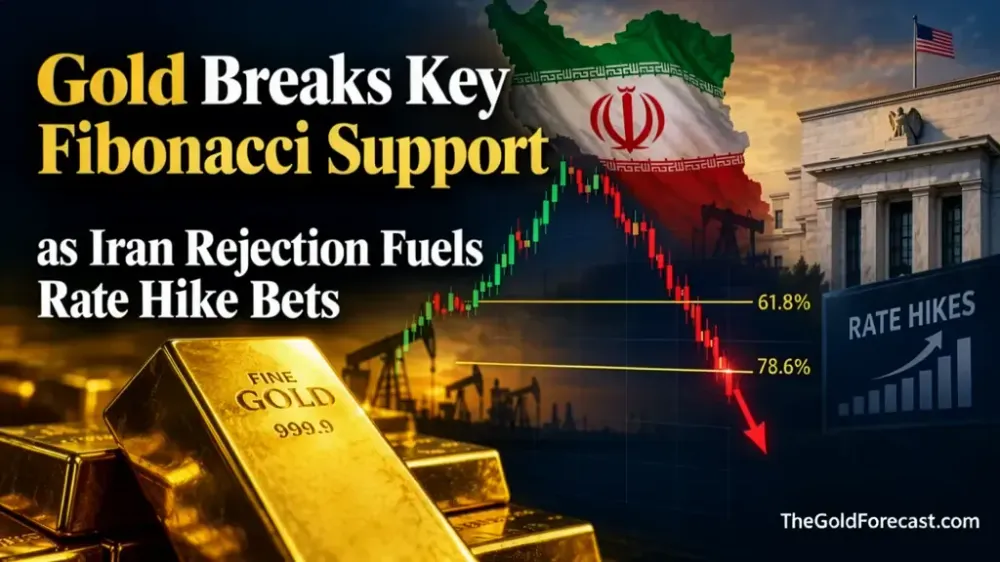
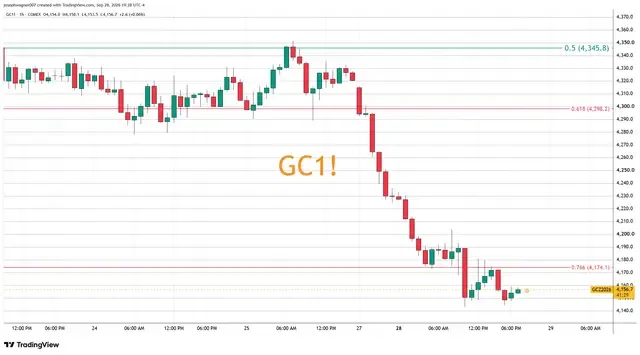
Gold and silver both fell hard today, breaking through the 61.8% and 50% Fibonacci retracement levels, respectively. For gold futures the chart damage was severe, as price sliced through both the 61.8% and 78.6% retracement levels of the August rally. In fact, gold suffered its largest single-day decline since June 9th, closing $172 below Friday’s close for a loss of 3.98%. Even more alarming was that gold closed only a few dollars off the low at $4,148, but the real picture of today’s drop is much clearer on an hourly candlestick chart.
With the Fibonacci retracement overlaid from the lows around $4,015 to the August highs at $4,755, we see that gold gaped lower on the opening hour and lost its critical support at $4,298 (61.8% Fib.) within the first hour of trading. From there it was hour after hour of red candles, some as large as $30, taking gold right down to the next support level at $4,174 (78.6% Fib.) by 4:00 AM ET. From 4:00 AM to 9:00 AM ET, gold attempted to hold above that level, but the 10:00 – 11:00 AM hour brought the day’s largest hourly decline, a drop of more than $38 in 60 minutes. Gold spent the rest of the session trying to recover the 78.6% level, but by the close it was clear that $4,174 is now resistance. In a single session gold lost the most important technical support it had and the level beneath it, and the move was triggered by one geopolitical development over the weekend.
Iran’s Foreign Minister Abbas Araghchi floated an offer Friday at the UN General Assembly. Reopen the Strait of Hormuz within seven days, he said, if Washington ended its naval blockade, lifted sanctions on Iranian oil, and released frozen funds. Trump turned it down over the weekend, telling reporters, “They made a proposal but I rejected it,” according to CNBC. Diplomacy is not fully shut, as Trump told Axios he expects talks to resume this week, but the Wall Street Journal reported he signaled to aides that US strikes may resume after November’s midterms. Roughly a fifth of global oil supply routes through the strait, and Brent crude reversed hard on the rejection, rising more than 3% toward $107 a barrel.
The mechanism runs through the Fed rather than through fear, which is why gold fell on rising war risk instead of rallying. Oil near $107 adds directly to headline inflation, exactly what hawkish policymakers point to when they argue for more tightening. The Fed already raised its target range to 3.75%-4.00% on September 16, its first hike since 2023, and money markets now price a 65.9% chance of another hike at the October 27-28 meeting, up from 57.6% a week ago and just 9.4% a month ago. Cleveland Fed President Beth Hammack warned against letting the public “accept elevated prices as the new normal,” while Philadelphia Fed President Anna Paulson said “modest additional tightening may be necessary.” Gold pays no yield, so every added basis point of expected tightening raises the real return on cash and short-term paper and makes the metal less competitive to hold.
Silver fell even harder, down roughly 4.7% to about $61.29 and pushing the gold-silver ratio out to about 67.7-to-1. When a move is really about the dollar and the discount rate, the higher-beta, more industrially exposed metal typically falls further and faster, and that is the signature we saw today rather than anything silver-specific. Saxo Bank also noted that a large share of the selling hit during Asian trading hours, with China’s Golden Week beginning Thursday. Traders in the region often lighten positions ahead of a week-long closure, so part of today’s drop may be calendar-driven profit-taking layered on top of the real macro pressure.
The next tests arrive quickly, with the September PCE report and Friday’s nonfarm payrolls both landing ahead of the October 27-28 FOMC meeting. A hot inflation read or a resilient jobs number would likely push hike odds higher still, while a soft print would be the first real chance for those odds, and gold, to reverse. Keep an eye on Brent as well; as long as it holds above $100 and the Hormuz standoff persists, the inflation-to-rate-hike pipeline pressuring gold stays open. Technically, gold must first reclaim the 78.6% level at $4,174 and then the 61.8% level at $4,298 before bulls can claim any repair to the chart. Failing that, all eyes turn to the $4,015 low, the 100% retracement, where a break would erase the entire August rally.