Gold stuck but central bank policies pose downside risks next week
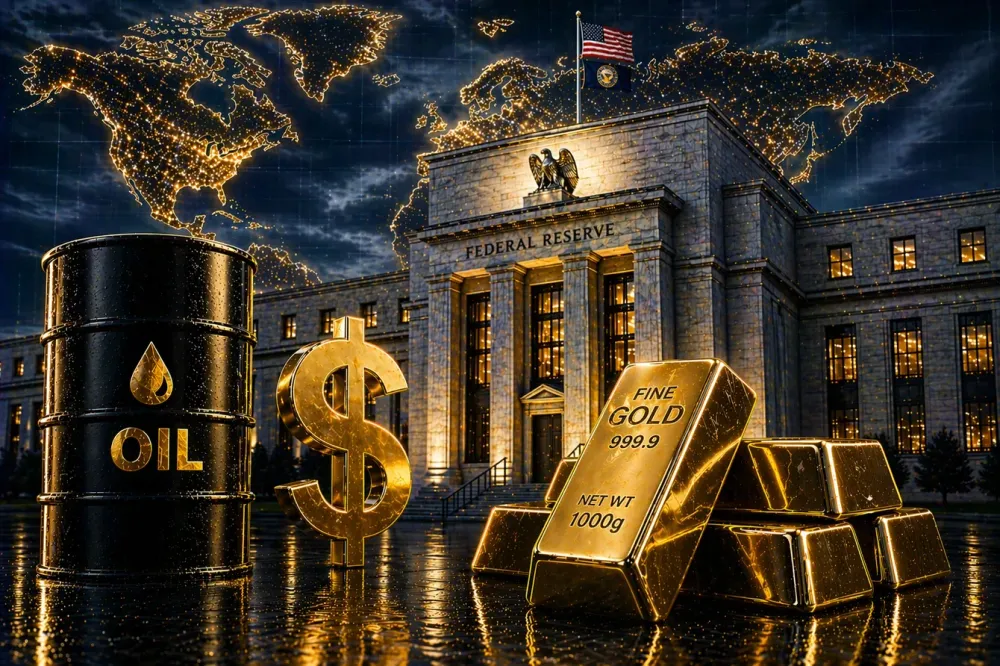
Although gold continues to find initial support around $4,700 an ounce, the market remains stuck in neutral, unable to break above $4,800 an ounce, as geopolitical uncertainty continues to favor the U.S. dollar as a safe-haven asset.
Along with the ongoing uncertainty surrounding the ceasefire and peace negotiations in the Middle East, some analysts have said that the gold market could retest the bottom end of its broader range next week, as higher oil prices also fuel inflation fears, which in turn could force the Federal Reserve to maintain its current monetary policy for the foreseeable future.
“As fears over inflation shocks mount, central banks are likely to keep rates steady or even hike down the road,” said Lukman Otunuga, Senior Market Analyst at FXTM. “This hawkish reality is bad news for zero-yielding gold despite the risk-off sentiment.”
“Chaos and uncertainty around the ongoing Iran conflict have eradicated hopes of the Fed cutting rates in 2026. So, rates are expected to be left unchanged in April, with Powell under the spotlight,” he added. “On the technical front, prices are back below the 100-day SMA. A weekly close below this point may open a path toward $4,600 and $4,450. Should prices keep above $4,700, bulls may target the 50-day SMA at $4,870 and $4,900.”
Looking to next week’s Federal Reserve meeting, market forecasts surrounding Federal Reserve monetary policy have been extremely volatile because of the economic and geopolitical turmoil. Last month, markets actually started to see a small possibility of a rate hike by the end of the year.
However, that unlikely scenario has been priced out, and now markets are shifting between whether or not the Federal Reserve will cut rates. Last week, markets saw a 50/50 chance of a rate cut by year-end; however, now markets see less than a 40% chance of easing.
Adding to the already precarious monetary policy environment, the U.S. Senate Banking Committee has started the confirmation process of Kevin Warsh to be the new Federal Reserve Chair. However, it is unlikely he will be confirmed by mid-May, when Jerome Powell’s tenure ends.
Ole Hansen, Head of Commodity Strategy at Saxo Bank, said that although gold remains caught in a $200 range between $4,650 and $4,850 an ounce, the market remains positioned to capitalize on solid long-term fundamentals.
“Federal Reserve Chair Jerome Powell is unlikely to materially shift his stance as long as the U.S. economy continues to show resilience, albeit at a modest pace. More concerning, however, is the trajectory of U.S. public finances, where mounting fiscal pressures—driven by tariff-related repayments and elevated military spending—continue to add to an already sizeable debt burden,” he said. “Looking ahead, the underlying case for gold remains intact. Once geopolitical tensions surrounding Iran begin to ease, investor focus is likely to return to the structural drivers that supported gold’s recent rally.”
Along with the Federal Reserve, the Bank of Japan, the Bank of Canada, the Bank of England, and the European Central Bank will all be holding monetary policy meetings this week, and markets expect them to maintain a wait-and-see stance because of the ongoing chaos in the Middle East.
Economists have also said that markets will be closely attuned to inflation data, as the U.S. government will release the first print of its first-quarter GDP and Personal Consumption Expenditures report.
Economists note that the inflation data will be for March and is expected to show the impact the war with Iran has had on consumer prices.
Along with higher inflation, some analysts have warned that gold’s technical outlook is starting to break down, as prices have been unable to hold above $4,800 an ounce.
Although the precious metal has held initial support at $4,700, it is ending a four-week winning streak. Spot gold last traded at $4,716.10 an ounce, down more than 2% since last Friday.
Razan Hilal, Market Analyst at Forex, said that gold and silver are exposed to potential downside, as prices remain below $4,880 and $84 an ounce, respectively.
“On the daily chart, gold is forming a consolidation structure with higher lows from the $4,080 level and capped highs below the $4,880 resistance,” she said. “This setup resembles the structure observed after the February rebound into the March 2026 highs, leaving two key scenarios in focus: a breakout above resistance or a breakdown below trendline support.”