Gold drives above $4,700 as Iran peace progress weakens U.S. dollar, analysts warn risks remain
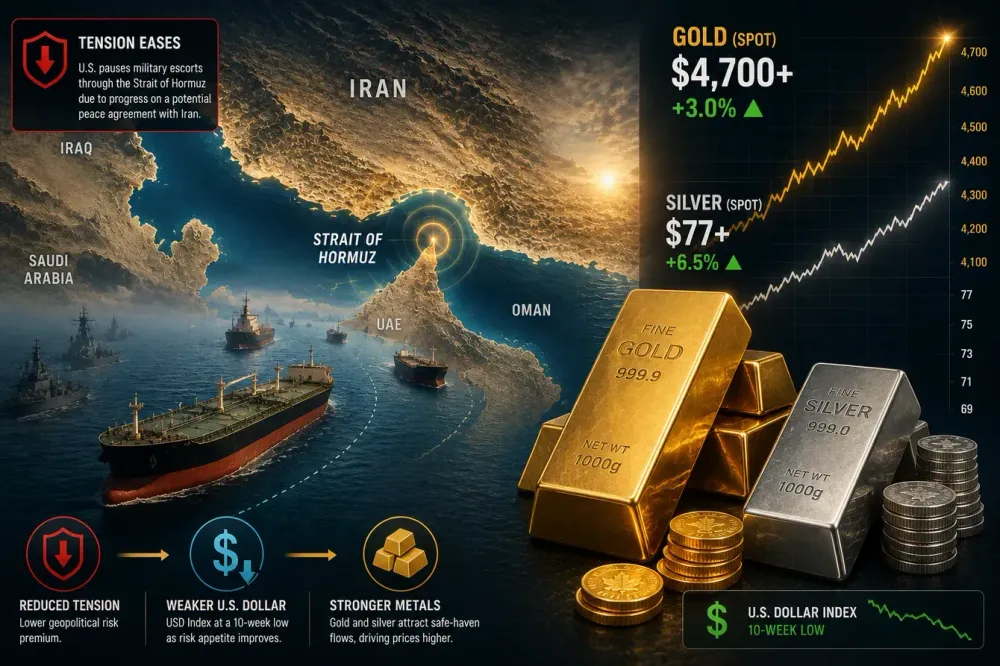
Progress on a potential peace agreement between the U.S. and Iran has shifted geopolitically sentiment and breathing new life into gold and silver; however with prices still below key resistance points some analysts warn that the precious metals aren’t out of the woods just yet.
Ahead of the North American open, spot gold prices pushed above $4,700 and ounce, up more than 3% on the day. Meanwhile, silver prices are solidly above $77 and ounce, up 6.5% on the day.
Analysts said that the precious metals are benefiting from a weaker U.S. dollar, which is trading at a 10-week low after U.S. President Donald Trump announce that he would paused the US military’s escorts through the Strait of Hormuz, due to “great progress” being made towards a “complete and final agreement with the representatives of Iran.”
Along with a weakening U.S. dollar, the positive news from the Middle East is also driving oil prices sharply lower. Easing inflations fears that have forced central banks into more hawkish posturing on monetary policies.
In a note Wednesday, David Morrison, Senior Market Analyst at Trade Nation said that although there is still a lot of questions around peace negotiations, anything that removes some uncertainty will be positive for financial markets.
“It’s unclear what may be in the agreement, especially concerning the reopening of the Strait of Hormuz. But investors seem confident that, ten weeks into the war, an end to hostilities may be in sight,” said Morrison.
However, Morrison also said noted that the war has significantly impacted the global economy and inflation, which means rate cuts this year aren’t guaranteed.
“It’s worth noting that investors see a 20% probability of a Federal Reserve rate hike by year-end. This could limit the upside in gold should the dollar resume its rally,” he said.
Simon-Peter Massabni, Head of Business Development at XS.com, said that he sees the new momentum in gold as more than just technical move and could reflect a shift in global risk appetite.
“This type of de-escalation, even if temporary, creates a dual-impact environment; on one hand, it supports risk assets, and on the other, it reinforces safe-haven demand for gold due to the fragility of stability, which explains the current delicate balance in price action,” he said.
However, Massabni also noted that golds gains could be limited in the near term as the Federal Reserve continues to walk a fine balance with its monetary policies. He explained that there is no urgency for the central bank to cut or hike rates this year.
He added that the gold market needs to see a further weakness in the U.S economy, particularly further softness in the labor market, to see sustainable higher gains.
“The upcoming Nonfarm Payrolls report, I believe it represents a potential turning point for market direction in the short term. If the data comes in weaker than expected, it would strengthen expectations of rate cuts and directly support gold. Conversely, if the data is strong, we may see some corrective pressure on the precious meta,” he said.
Despite near-term volatility, Massabni said that gold’s long-term outlook remains bullish.
“Investing in gold at this stage requires a deep understanding of the balance between short-term and long-term factors. Markets do not move based on a single event, but rather through a complex interaction between politics, economics, and investor psychology. From this standpoint, I see gold as maintaining its appeal as a key hedging instrument, and any current volatility should be viewed within a broader context reflecting structural shifts in the global financial system, rather than merely short-term reactions to news,” he said.