Gold sheds $47 as rate-hike fears and a thin Trump-Xi statement compound the sell-off
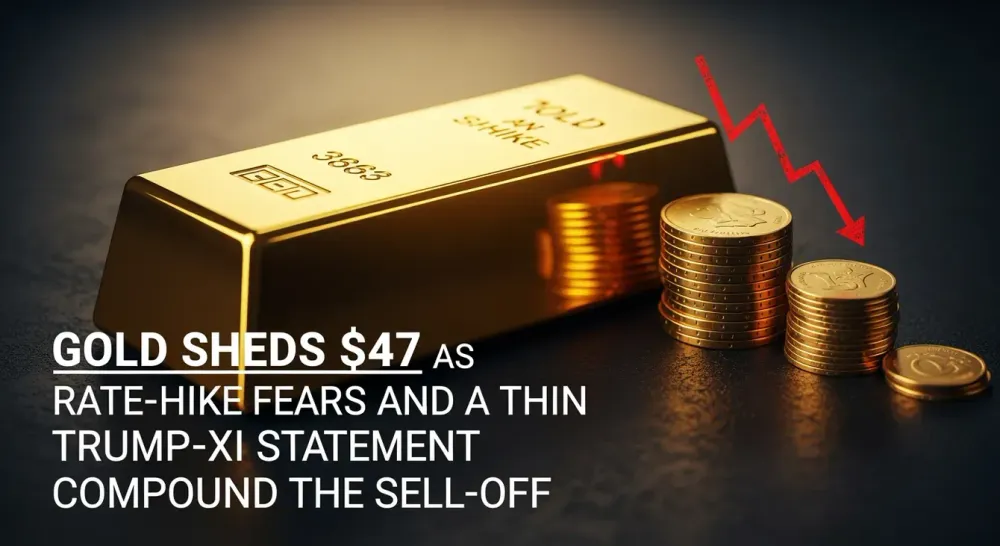
Gold suffered its third consecutive session of losses on Thursday, dropping $47 per ounce in a sell-off that extended the metal's retreat from its all-time highs and pushed prices deeper into correction territory. The decline was driven by a fresh wave of inflation data that cemented expectations the Federal Reserve will hold rates at elevated levels through year-end — and increasingly, that the next move could be a hike rather than a cut. A much-anticipated diplomatic summit between President Trump and Chinese President Xi Jinping offered little in the way of relief, delivering a joint statement long on principle and short on concrete action.
Thursday's catalyst arrived in the form of import and export price data showing both measures surged well beyond expectations in April, logging their largest combined increase since March 2022. The primary driver was fuel import costs, a direct consequence of the ongoing Iran conflict and the disruption to tanker traffic through the Strait of Hormuz. The report landed on top of an already punishing inflation week: Tuesday's Consumer Price Index came in at 3.8%, the highest reading since May 2023, and Wednesday's Producer Price Index posted its steepest monthly gain since early 2022. Three consecutive inflation beats in three trading days have left little room for market participants to hold onto any scenario in which the Fed eases policy this year. Odds of a rate hike before December have now climbed to roughly 30%, an extraordinary shift in market pricing from just weeks ago.
The $47 decline encapsulates the dilemma now facing gold investors. The metal has historically served as an inflation hedge, and by that logic, readings of 3.8% CPI and surging wholesale prices should be tailwinds. They are not, because the inflation currently running through the U.S. economy is being driven by an oil shock — one that simultaneously forces the Fed to maintain or tighten policy, raising the opportunity cost of holding a non-yielding asset like bullion. Until that mechanism breaks — meaning either the Iran conflict de-escalates, oil retreats, or inflation cools — gold faces a structural ceiling imposed by its own hedge rationale working in reverse.
The Trump-Xi summit in Beijing, the most closely watched diplomatic event of the month, failed to deliver the market catalyst bulls had hoped for. A joint statement from the first day of talks confirmed that both sides agreed Iran should never develop nuclear weapons and endorsed the principle of free transit through the Strait of Hormuz — a gesture toward easing energy market tension. But analysts noted the communiqué omitted any mention of Taiwan, produced no concrete trade commitments, and left the key economic friction points — rare earth export controls, tariffs, supply chains — unresolved. The outcome was described by one observer as "very much the status quo." Two additional sessions are scheduled for Friday that could yet shift the picture, though market expectations have been reset accordingly.
Beijing entered the summit with a strong hand. China has curtailed exports of rare earths critical to U.S. weapons procurement, and recently invoked a previously unused 2021 statute to block Chinese entities from complying with American sanctions. Analysts at Trivium China characterized Beijing's negotiating position as confident and its playbook as highly effective. For gold, an inconclusive summit preserves geopolitical uncertainty — a factor that ordinarily supports safe-haven demand — but the rate headwind proved the dominant force on Thursday, overwhelming any residual flight-to-safety bid.
Thursday's retail sales print, up 0.5% and in line with forecasts, provided no relief. A firmer consumer spending backdrop reinforces the case for a Fed on hold, adding one more data point to the wall of evidence that the central bank has little political or economic cover to ease. The dollar strengthened on the combination of hot inflation data and solid consumption figures, applying additional pressure to dollar-denominated gold prices by making bullion more expensive for overseas buyers.
Friday's continuation of the Trump-Xi talks represents the most immediate variable. Any credible signal that the Strait of Hormuz could reopen, or that a diplomatic framework for the Iran conflict is taking shape, would likely send energy prices sharply lower and allow inflation expectations to cool — conditions that would rapidly reprice the Fed outlook and, with it, gold's near-term trajectory. Until then, the bears hold the momentum.