
Gold steadies above $4,530 as Middle East supply signs cool inflation fears
Gold climbed back above $4,530 per ounce on Wednesday, halting a slide that had driven prices to a two-month low of $4,490 the prior session, as easing tensions in the Middle East offered investors a reason to revisit their most hawkish assumptions about the path of U.S. monetary policy.
The metal’s recovery tracked a concurrent respite in the Treasury market, where yields pulled back modestly as the prospects for an imminent resolution to the Iran conflict reduced the perceived threat of a sustained energy-driven inflation surge.
President Trump stated on Wednesday that the United States was close to reaching an agreement to end the conflict with Iran, remarks that carried additional weight after three supertankers were observed exiting the Persian Gulf laden with cargoes bound for Asia.
The departures offered the first tangible evidence that the Strait of Hormuz blockade, which has choked commercial shipping and sent energy prices to post-war highs, may be nearing an end. Oil prices retreated on the news, and with them the inflation premium that had weighed most heavily on gold over the past week.
The connection between energy markets and gold has been the defining dynamic of recent sessions. The Hormuz blockade drove a surge in producer and consumer prices that pushed U.S. inflation to a three-year high, hardening the Federal Reserve’s resolve and stripping gold of the accommodative policy backdrop it had benefited from earlier in the year.
Wednesday’s developments supported the possibility that inflation could rise less than feared, dialing back — if not eliminating — the risk of an additional tightening cycle. The effect of this sentiment shift can be seen in todays near 5% drop in oil prices taking WTI crude below $100 a barrel, causing the inflation headwinds to lessen as sentiment shifted.
The Fed’s internal divisions, laid bare in minutes released Wednesday from its most recent meeting, reflect the genuine uncertainty now confronting policymakers. Multiple members dissented against the easing bias in the Fed’s last rate hold, and a majority noted that it may be appropriate to raise interest rates this year should inflation remain above the 2% threshold. The minutes offered no comfort to those expecting cuts, but markets interpreted the conditional language as leaving the door open to a more benign outcome if energy prices continue to retreat.
Pricing in the interest rate options market reflects the resulting ambiguity. Traders are now roughly split on whether the Fed delivers a rate hike by December or leaves rates on hold through year-end — a binary outcome that is likely to keep gold volatile in the weeks ahead. CME Group data shows 97.4% of participants expecting no change at the June meeting as recently as Tuesday. Still traders are pricing in a slight chance of multiple rate hikes by year’s end, something nonexistent a month ago.
The broader context for gold remains one of contested fundamentals. The World Gold Council reported record global demand of 1,230.9 tonnes in the first quarter of 2026, supported by a 42% annual surge in bar and coin purchases led by Asian retail investors.
Central banks are on pace for approximately 755 tonnes of purchases in 2026 according to J.P. Morgan Global Research, which maintains a fourth-quarter price target of $5,000 per ounce. Yet those structural tailwinds have struggled to offset the force of a repricing in rate expectations that, at its peak last week, saw the LBMA Gold Price PM drop 4.5% to $4,528 and trim gold’s year-to-date gain to just 3.7%.]
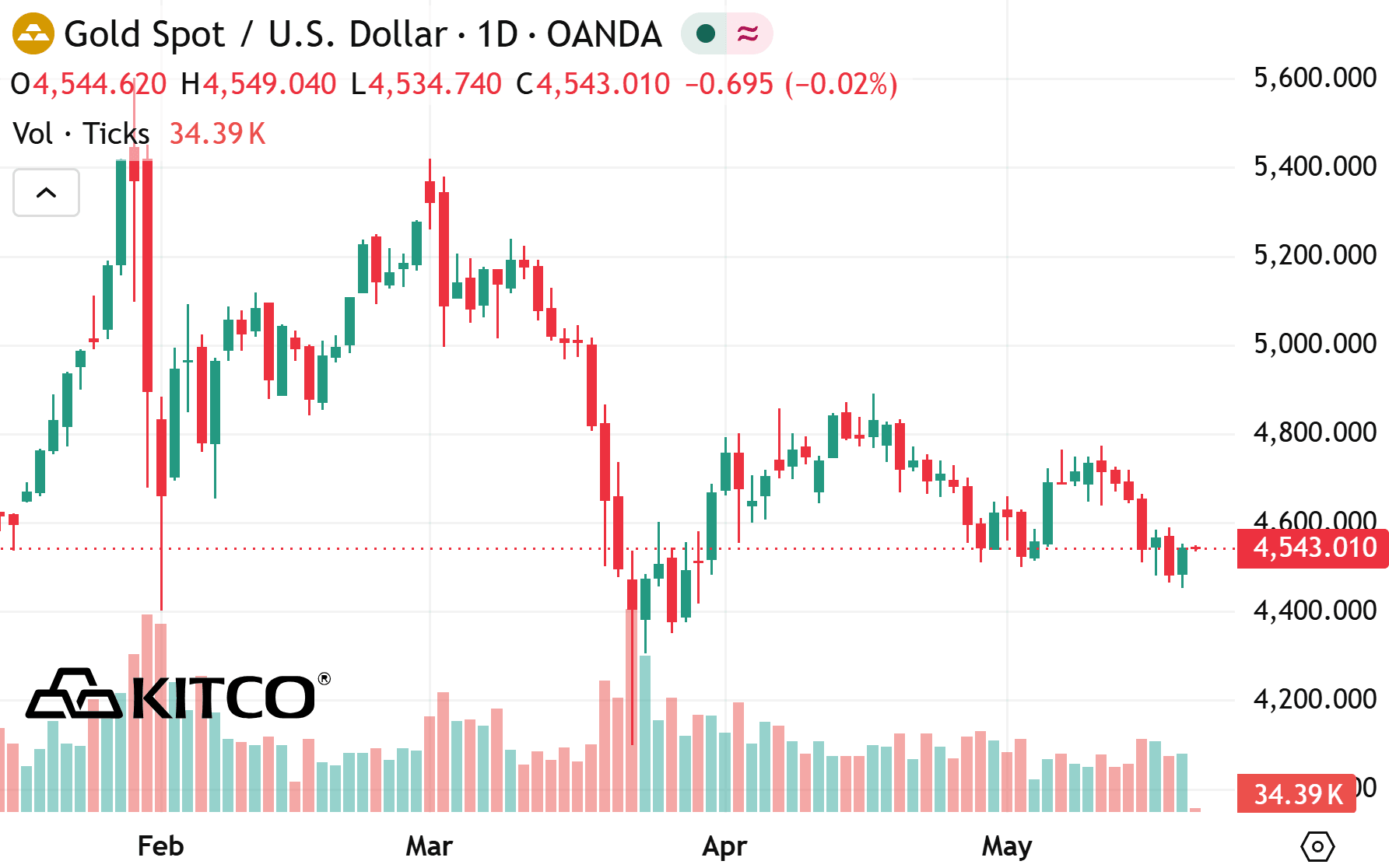
Whether Wednesday’s stabilization marks a durable floor or a brief pause in the downtrend will depend on how quickly and completely the Iran situation resolves. A verified and lasting reopening of the Strait of Hormuz would remove the energy shock underpinning the inflation overshoot, soften the case for further Fed tightening, and likely restore the interest rate sensitivity that drove gold’s spectacular climb to its January high of $5,595.
A breakdown in talks, on the other hand, would revisit the $4,466–$4,423 technical support range that analysts had flagged as the next downside target. With markets split on the Fed’s next move and a peace deal still unconfirmed, the metal’s direction remains hostage to headlines.